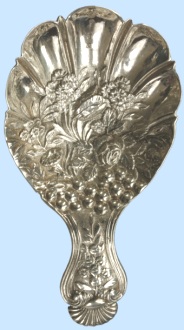
Solid silver caddy spoon with typical wide, round bowl and short handle. Elaborate decoration is not unusual. Made by Birmingham silversmith in reign of George IV, c1829. Photo by Clark Mills
If you have a nice tea caddy, you may also want a caddy spoon. In the early years of tea drinking in Europe and America, either the lid of the caddy was used for measuring out tea leaves, or a long-handled strainer spoon, but in the 1760s people started to use special silver spoons instead, with short handles so they would fit easily inside the caddy, on top of the tea leaves.
Silversmiths created a wide variety of spoons, and yet certain shapes were particularly popular: shells, especially, and a variety of leaf shapes. Shell-shaped spoons may have echoed the shells packed in tea consignments for merchants to sample the leaves. Fluted shells were a good way of strengthening thin silver spoon bowls along the lines of the fluting. Shovels and ladles are styles of spoon that may sound purely functional, but they too can be very decorative, with handles made of ivoory or mother-of-pearl, and highly collectible.
Spoons from the Georgian era, made by 1830, are very desirable now. A good silver spoon may well fetch several hundred dollars at auction, and a four figure price is not impossible. Silversmiths in Birmingham, England produced a high proportion of these early caddy spoons.
If you come across a pierced caddy spoon, it was probably intended to serve as a “mote spoon”. It could help pick out any mote or stray tea-leaf floating in the tea-cup, as well as being used in the ordinary way for measuring tea into the pot.
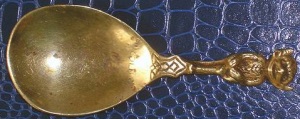
Caddy spoon in brass with Lincoln Imp handle - a design associated with Lincoln Cathedral. Photo by Terry Whalebone
Once tea was no longer a luxury, tea-drinking became widespread, more affordable caddies appeared, and caddy spoons became available cheaper versions. By the early 20th century, die-stamped alloy caddy spoons were a popular souvenir gift for people with modest incomes, and were on sale in every seaside town in Britain. They could be decorated with local motifs or scenes, enamelled crests, embossed placenames etc.
At the other end of the scale, one of the most valuable caddy spoons sold at auction in the last few years was designed by the 20th century craftsman Omar Ramsden. His 1931 art nouveau silver caddy spoon with semi-precious stones in a knotwork handle fetched over £2000.
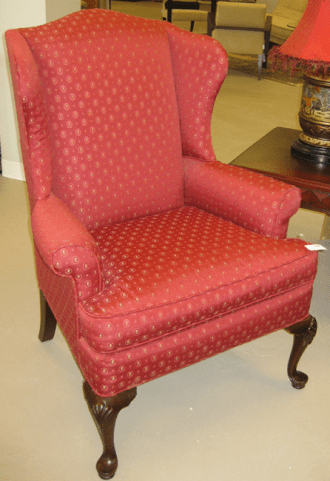
Vivid red upholstery on this reproduction wing chair might have suited Colonial and Georgian tastes. Cabriole legs are a traditional touch. Photo by NCJW Home.
Wing chairs are sometimes called fireside chairs, and for good reason. Their design is perfect for enjoying the warmth of a fire while your back and sides are protected from chilly draughts.
These chairs were not the earliest furniture to use this approach to keeping warm. Wings were also used on some of the high-backed wooden settles (benches) found in English manor houses and inns long before the new kind of upholstered chair brought an extra level of comfort to the late 17th century. We now know these as wing or wingback chairs.
The same chairs soon appeared in colonial America. Like other Queen Anne furniture of the early 1700s, they had cabriole legs and curving lines that distinguished them from earlier styles. The famous cabinet-makers of the age, like Chippendale in London, designed elegant frames to set off the upholstery.
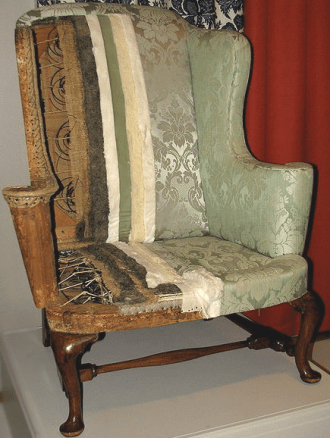
The picture of a wing chair stripped back by museum curators reveals that early padding was not as generous as we expect from a modern armchair. Fabrics were often vividly coloured. Bright patterns were seen in both colonial and Georgian drawing rooms. Restorers of 18th century antiques often favour plain colours, but this is not necessary for authenticity. Leather upholstery is also an option.
Original 18th century shape on the left after layers of 20th century upholstery (right) were stripped away. A New England easy chair with wings. Photo by Bdesham.
If you look at antique French wing chairs, or other chairs echoing the Louis XV or Louis XV period, you may see a lower seat in the bergère style. Similarly, in 18th century England Hepplewhite tried lowering the seat in his designs. He called the wings saddle-cheeks, perhaps knowing that they were called cheeks (joues), not wings, in France. Ears is their other name, used in some parts of Europe, German Ohrensessel for example, and remembered in the old-fashioned British name lug chair. (Lug meant ear.)
American wing chairs, also called easy chairs, were considered suitable as bedroom furniture for anyone frail or tired, sitting quietly in their room. Both antique and modern wing chairs may be associated with elderly people; a firm seat and a back with built-in draught-proofing offer an appropriate kind of comfort, and remind us that another name for this piece of furniture is grandfather chair.
In Britain, wing chairs were thought of as essential for a comfortable living room or parlour. Victorian writers describing scenes of idealised family life round a blazing hearth often mentioned a fireside chair. 19th century chairs were often more generously padded than earlier wingbacks – sometimes with a very firm horsehair stuffing.
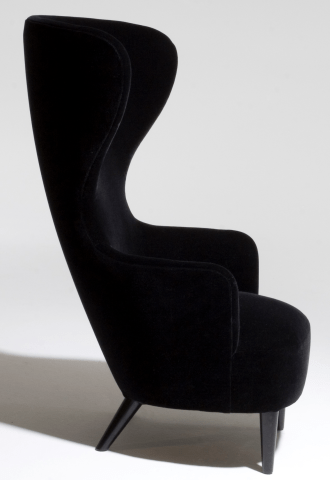
A 21st century wingback inspired by 18th century style, by George Smith for the Tom Dixon design studio. Black velvet stuffed with cotton and boar bristle. Photo by pressattomdixon.
Contemporary designers now produce all sorts of shapes and sizes of wing chair. Some blend the wingback concept with cutting-edge contemporary design, and yet the early Queen Anne shape has an enduring popularity. If you want a true antique, remember that “Queen Anne style” is just that: a style and not a promise that a chair is 300 years old.
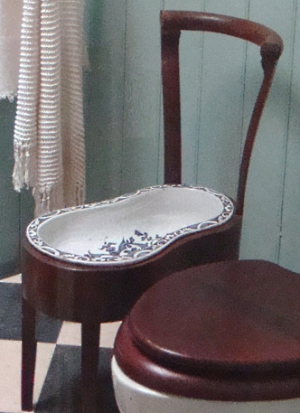
Porcelain bidet from c1800 in wooden chair-shape frame, probably French export to UK, placed alongside newer bathroom fittings. Photo by HomeThingsPast.
Do you have a bidet in your bathroom? It’s always been a difference between English-speaking countries and France. Bidets have never quite caught on in the USA or the UK, except for an occasional “trend” that never really went very far. Some upper class ladies in 19th century England had French-made bidets, and in the 1980s British sanitaryware retailers started stocking bidets.
But in France there’s a bidet in every bathroom, isn’t there? Not any more. In recent years the bidet has been disappearing from new French bathrooms. Only 40% had bidets included in the mid-1990s, as compared with 95% in the 1970s, according to the authors of a French book on the history of the bidet.† In 1995 Italy produced 15 times as many bidets as France.
Bidet-style arrrangements for personal hygiene are not limited to Europe. Arabic-speaking countries use them, and Japan is a leading producer of high-tech bidet/toilet combinations (also called washlets), with jets of water washing after you flush, and warm air following on. This type is used in nursing homes.
Bidet history
This kind of bidet looks like a stool when the lid is on. As used in a 19th century bedroom or dressing room. Photo by Moresheth.
In France beautful bowls set into elegant seats were fashionable with the upper classes in the 18th and 19th centuries. Napoleon’s will left his silver-gilt bidet to his son. A 1751 rosewood-veneered bidet of Madame de Pompadour’s is preserved at Versailles near Paris. The basin in hers is decorative like this slightly later floral earthenware one.
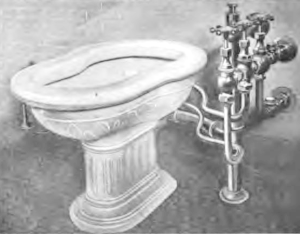
That last link and the first picture on this page show the curving shape of the antique bowls. This shape explains why the bidet once had nicknames like violin-case or little guitar. Originally the word bidet itself referred to the wooden furniture originally used for holding the bowl, and meant pony.
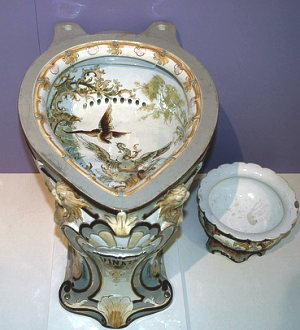
Debates about who invented the bidet are not likely to be settled any time soon. The French or the Italians? After all, who can say when someone first set a basin of water on a stand at a convenient height for washing the more private parts of the body?Bidet from the era of indoor plumbing - note the row of little holes - in an Austrian museum. Photo by Alfred Diem.
The earliest written information we have about bidets comes fom a Paris cabinet-maker whose business literature in 1739 offered bidets designed with backs and hinged lids. Rémy Peverie also suggested the possibility of making two-person bidets for his aristocratic clients. Now there’s an idea that didn’t catch on – as far as I know.
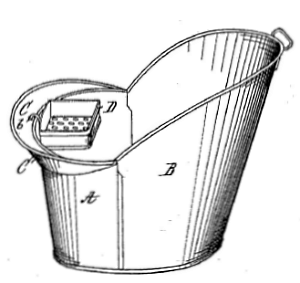
Bidet and footbath combination patented 1879 in USA. Remove soapdish and sit (awkwardly?) on mini-shelf C to use it as a bidet. Invented by Merwin Church of Chicago, owner of large hardware store.Bidet in USA, about 1910.Controls for a bidet-toilet aka washlet in a Tokyo hotel. Photo by William Kumberger.
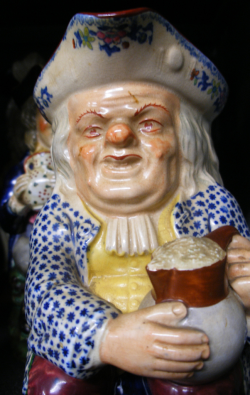
A Toby with a foaming jug, plenty of painted decoration on jacket, hat and red-nosed face. Photograph by scrappy annie
Toby jugs portray a character whose story is rather unclear. He reminds some people of Shakespeare’s jovial, disreputable Toby Belch, and he very likely has something to do with an old song about Toby Fillpot.
Dear Tom, this brown jug that now foams with mild ale,
(In which I will drink to sweet Nan of the vale),
Was once Toby Fillpot, a thirsty old soul,
As e’er drank a bottle, or fathomed a bowl….
(1761, by Francis Fawkes, a clergyman)
This ceramic character was born in the English Staffordshire potteries region in the 18th century, fully clothed in breeches, coat, and a tricorn hat, seated, and clutching his own jug of ale. Sometimes Toby holds a pipe, takes snuff, or has a barrel between his feet.
Although Tobies are real glazed jugs with a handle behind and a spout in front, usually formed by the front point of the three-cornered hat, they have probably never held much liquid, and were originally intended to be decorative pieces of pottery.
Toby inspired many other character jugs, and they have been made more or less continuously over the last 250 years. Some are fictional personalities, and some are based on real people. They generally have humorous, earthy faces. Character is drawn in their wrinkles, and there may be an element of caricature. Themed sets are also possible.
Were any early Toby jugs made outside England?
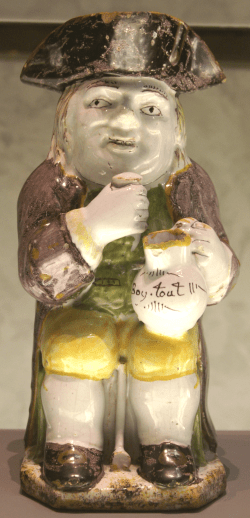
This jug is very Toby-like, well-supplied with drink and a clay pipe resting between his legs, but he was made in Brittany, not England, probably before 1800, and he has a bicorne, 2-pointed hat. Is he drinking wine? Photo by Pymouss
Everyone knows Toby is an Englishman, and that’s why I was surprised to find that a French museum (Musée de Bretagne) has a Tobyish jug made in Rennes, probably 18th century. (See photo) His jug says Boy-Tout or Drink-All. In France of the 1700s this was a slangy, joky word to do with finishing your drink in one swig:* rather like the Toby Fillpot character, that “thirsty old soul”. As far as I can discover, Toby’s French cousin is called Jacquot, but please comment if you know more.
Victorian and Edwardian attitudes to Toby jugs
In 1904 the writer Gertrude Jekyll thought of a Toby jug as an ornament to sit above the fireplace on a cottage or farmhouse mantelpiece along with other “coloured glazed pottery and low-class porcelain”.
She was not the only person of that period who was unimpressed by earthenware Tobies, whether recently-designed Victorian ones or earlier jugs from the Georgian period. Edward Downman, who wrote English Pottery and Porcelain in 1896, doesn’t sound too enthusiastic, even when he admits that the older antique jugs were made by expert craftsmen.
…the most eminent potters of a bygone age may be associated with this grotesque and commonplace ware…
Now Toby jugs are admired by many and collected by enthusiasts. Genuine antiques may cost several hundred pounds in their home country. Collectors can specialise in particular types – pearlware or Wemyss ware, sailor or farmer Tobies, for example – and they expect the best jugs to be sold by upmarket auction houses and antique dealers.
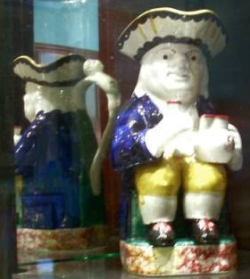
This Toby jug's handle is reflected in the mirror behind him. Photo by HomeThingsPast.
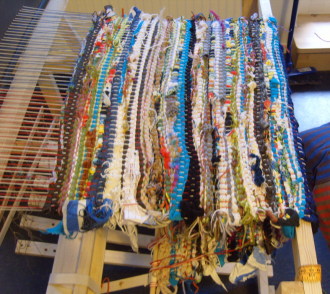
Rag rug made with strips of cloth woven into warp threads on a loom. Photo by Travis Meinolf
Rugs made from strips of cloth existed well before factories began producing cheap fabric, but not in anything like the same quantity. Even in quite poor households, rag bags of the 1800s were filling up with old clothes and scraps left over from dress-making. In the factories, there were clippings and oddments to be sold off cheaply or swept up by employees. Cotton feedsacks gradually became available too. Rag rugs created from scraps on a woven background (the second and last kinds in the list below) could use old jute sacking or cheap burlap as a foundation. These materials were easily available in many parts of North America and Europe by the middle of the 19th century. With time, and a little skill, families could warm and decorate their floors.
By 1900, some rag rugs were less about thrift, and more about craft. There was a movement towards careful design, and more elaborate techniques, and craftswomen started to buy and/or dye fabric with particular patterns in mind. This interest in rug-making as an aesthetic craft was stronger in the US than in the UK, where rag rugs were mainly seen as an economical choice for poorer homes until the mid-20th century. While Britain tended to dismiss rag rugs as “working-class”, American county fairs and exhibitions offered prizes for rag rugs alongside patchwork quilts and other textile arts.
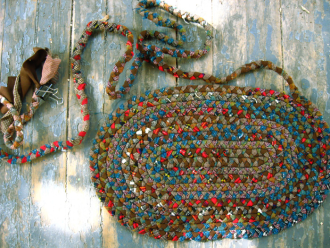
Cloth strips are braided. The braid is coiled round, secured with stitching, to make this oval rug. Photo by Jodi Green
There are many varied ways of making cloth remnants or “rags” into floor coverings, but this is a brief outline of the types known in the Victorian era.
Rugs woven on a loom: perhaps a linen warp thread with wool or linen strips used for the weft. These are probably the oldest kind. “List carpets” in 18th century England and colonial America were one of the cheapest kinds of soft floor covering. Sometimes woven lengths were sewn together to create rag carpeting.
Rugs made with cloth scraps looped through a loosely-woven canvas or burlap background. The rags can be hooked through from the upper side or poked through from underneath, creating varying surface textures from smooth to tufted. Implements for hooking or prodding ranged from home-made wooden pegs to factory-manufactured latch-hooks.
Rugs made by coiling joined-up lengths of rag. The coils of braided rugs, or mats made from fabric-covered cord were fastened with thread stitching or binding; crocheted versions need no sewing.
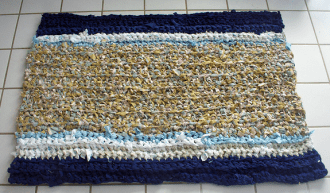
Knitted or crocheted rugs made in one flat piece.
Rugs, often small door-mats, made by stitching scraps onto backing material. Tongue mat is one name for these, based on the tongue-shaped pieces used in one popular design.
Rug crocheted from fabric scraps, making a 47 x 32 inch rectangle. Photo by Bethany.
Note: The UK had a large number of different regional names for the rugs in the second category, like clootie, proggy, proddy, clippy, stobbie or peggie rugs or mats. These now seem very attractive, admired for craft, design, and nostalgia reasons, but they were not appreciated by the wealthier classes in the 19th century.
Once in a while a reader sends me a splendid picture of a charming object. This fluting machine photograph came from George Short, and it made me curious about who, why, what, and where. George told me it was patented in 1876, a time when fluted ruffles were a fashionable trimming for ladies’ clothing. He also knew the inventor was Charles F. Dudley, but who was Dudley?
In the 1870s dressmakers were using pleated frills, also called fluting, lavishly. Dressmakers and classy laundries offering “fancy” ironing services both had plenty of use for a fluting machine. Fluters were sold for home use too. Classified ads from the 1860s to the end of the century show employers looking for a laundress who “thoroughly understands fluting”, or women claiming they could “do all kinds of fine laundry work, pleating, French fluting, starching, and polishing”.
So how did you heat the ridged rollers that pressed rows of fluting? You couldn’t really heat them on the stove as you did with flat irons for general ironing. Instead you heated a stick, called a heating iron, that went into the hollow interior of the roller: by letter ‘d’, Fig. 2 in the drawing below. These 19th century machines made pressing frills easier than it had been before.
Inventor and manufacturer
Dudley's 1876 patent showing his unique design for the lower roller: a piece cut away (at K) for the easier "introduction of the heating-iron" into the "cylindrical chamber".
The Dudley Fluter was invented by the owner of a foundry in Niagara County, NY. Charles F. Dudley was born in Lockport, and aged about 31 when he got his 1876 patent for “an improvement in fluting-machines”, when fluted ruffles were the height of fashion. He had started his working life as a moulder making moulds for casting metal objects.
He lived with his wife Alice just a few miles from the border with Canada where his mother Sophia was born, and ran a foundry in a small town. What did he do about marketing his invention? There were already plenty of other fluting machines available to cope with the fashion of the times. Dudley’s machine had a couple of small details which made it unique – and earned it the patent. The floral version is distinctive, and must have cost more than the plain kind with a smaller base.
We know both styles – plain and decorative – were manufactured as they occasionally come up in antiques auctions, but there is not much mention from their own era. In 1881 a “large size” of Dudley fluting machine was advertised in the Utica NY Morning Herald at $3.90. Along with other branded fluting machines, sad irons, and wringers it was available at H. Beckwith’s Old Stand in Genesee Street. The patent itself had been listed in the Hudson Evening Register soon after it was issued.
I can’t help feeling there is more to discover about Charles F. Dudley and his fluting machine. For instance, there are clues that he may have moved to North Tonawanda, NY, also in Niagara County. Do please add something in the comments section below if you know more.
Aspirational fashion picture showing dresses with fluted trimmings. In Godey's magazine for August 1870
Photographer for Dudley’s fluting machine is George Short of Campton, New Hampshire, who kindly granted permission for his picture to be published here. He retains all rights in his work so please note that you cannot reproduce it without permission. The Godey’s picture was found on this historical fashion site.
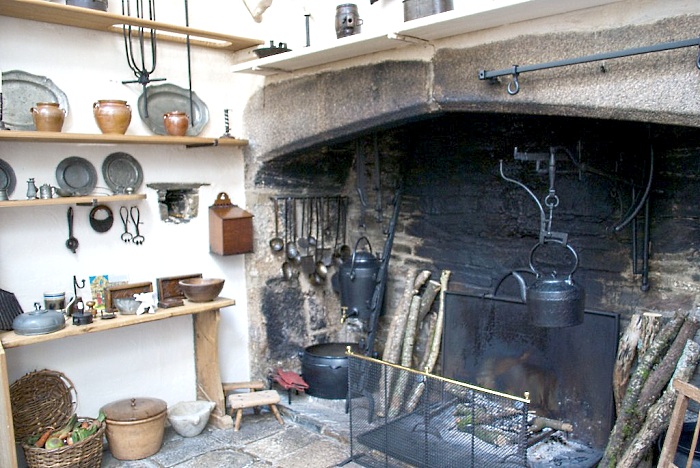
Open fireplace 10ft across in the 16th century kitchen at Cotehele House, Cornwall, England. See how many things you recognise before reading lower down the page. Photo by Lee Morgan.
Whenever I travel I look out for historic houses, especially if they have kitchens worth visiting, and enjoy picking out bits and pieces for a closer look.
And yet the room often isn’t the way it would have looked at any time in its life. The picture above is of a 16th century English manor house kitchen, amazingly unchanged in its basic structure. The Tudor open hearth with old iron pots and logs in a smoke-blackened fireplace is wonderful, but when did that protective fireguard appear? The things on the shelves come from various different periods in the life of the house. When and where did each pot, plate, or tool start its useful life? Does knowing matter? For myself, I enjoy seeing a kaleidoscope of things that have belonged to the house over the generations – but it’s still good to know what’s what.*
What can you identify in the picture?
Ironware
In the fireplace the classic iron kettle hanging on a chimney crane is centuries-old way of heating water. The crane may have arrived in the kitchen in the 17th or 18th century to replace a simpler kind of hanger. There’s also an “idleback” kettle tilter to help with pouring, probably not there originally. The urn to the left has a brass tap that may be relatively modern. The assorted spoons, ladles, and skimmers look timeless; you’d have to examine them hands-on to try guessing their dates. A trivet sits under the red cloth. Out of sight above the mantel-shelf are racks for roasting spits, and a cradle-spit for roasting small birds or joints of meat is hanging down into the upper left of the picture. Many big kitchens acquired fancier mechanised roasting equipment and cooking ranges or stoves well before 1900, but I understand this room was in use, unmodernised, until 1946. (There’s an old oven in one of the walls you can’t see.)
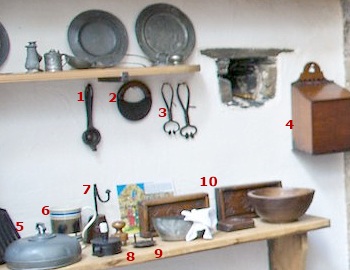
Selected utensils have been numbered to help with the discussion. Some are probably 19th century like the mug, and others could be much earlier, e.g. the pewter plates.
Smaller iron things on the shelves and nearby include two pairs of sugar cutters (3), a rushlight holder (7), lemon squeezer (1), and vegetable cutter (2) – suitable for hacking up root vegetables and big cabbages.
Woodware
A wooden salt box (4) hanging to the left of the fireplace has a traditional sloping lid and carved hanging loop. On the shelf below is a nice turned bowl. The two flat moulds with decorative carving (10) have left me wondering. Are they unusually long, flat butter moulds, or an uncommon kind of gingerbread mould with sides, or something else?
Biscuit pricker
The small wooden stamp with a round handle (8) is a biscuit pricker. With lots of little needles on the base, it was used before baking to perforate the dough for thin crackers, to help them stay flat in the oven. Think of it when you see the holes in British water biscuits or American graham crackers. The metal stamp (9) is probably a cookie cutter or biscuit docker: for cutting out small baked goods and possibly adding a pattern.
Water Biscuits: Into one pound of flour rub three ounces of butter, add a sufficient quantity of water to make it a stiff dough; well knead it, and roll it as thin as wafers; prick with a biscuit-pricker, and bake a very pale brown. (1870s UK recipe)
Other things
On the shelves are pewter plates and a metal cloche or dish-cover (5) that looks factory-made. The earthenware mug (6) is mocha ware, almost certainly for beer. This design with coloured bands and black-brown “trees” first appeared in the very late 18th century and was often seen in 19th century pubs where it might be government-certified as a pint or half-pint measure. Similar earthenware mugs were also used for the servants’ ale in big houses.†
On the floor, next to the big unglazed ceramic storage pot with lid, is a stone mortar without its pestle. It has those familiar triangular bits round the upper edge, but what are they for? The hole in the wall is the kind that might be used as a candle and rushlight store: handily near the fire for lighting.





 HomeThingsPast


