Butter tubs can be beautiful

carved butter tub norway
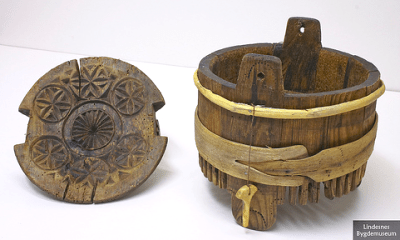
Norwegian butter tub with lid acting as butter stamp or mould. Made from wooden staves with the two longest fitting into the lid. Photo by Rolf Steinar Bergli.

Wooden tubs with fine carving inside the lid were traditional containers for a few pounds of butter in parts of Norway and other Scandinavian countries. Some were beautifully finished on the outside too, and could be used to take butter to festive gatherings and serve it attractively.

Because the interior carving gave the top of the butter an attractive design, these were called butter moulds by the treen (woodware) expert Edward Pinto. Obviously they did shape and mould the butter, but English-speaking antiques experts today tend to call them butter tubs.

Decoration on the outside was carved or painted or burnt, or all three. Tubs were constructed in the traditional cooper’s way. Made in the same way as barrels or buckets, with upright staves braced by bands around them, these tubs had two pieces of wood longer than the rest. They slotted into the lid and had a hole for the pin that fixed top and bottom together. Loose joins were sealed with rushes.

Size, shape, date
norwegian butter tub
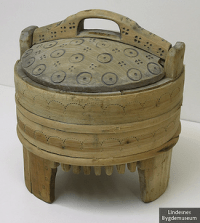
Norwegian butter carrier, classic shape, burnt pokerwork design on lid. Photo by Rolf Steinar Bergli

Other tubs have a neater finish than the first one pictured here, with wood curving smoothly round the whole surface, using techniques like Swedish svepask. They all tend to follow the classic form: round, on three little legs, a characteristic handle on top integrated with the side fastenings. They are often about 20cm (8in) high and wide. Pinto says a typical container holds 4 to 6 pounds (2-3 kilos) of butter, though some might carry more.

None of the tubs illustrated here is dated but I guess they are 19th century. I’ve seen one from 1837 and the overall style fits in with these. This extra special one is from the 1830s.

Containers of this type were also used for carrying stews, porridge and other semi-liquid food. I’d like to know if carving inside the lid is a decisive clue to their purpose. Or was one container used for both purposes? This would break with the usual rule that dairy utensils are kept separate and scrupulously clean to avoid souring the butter.

Wooden porringers
swedish painted wood tub
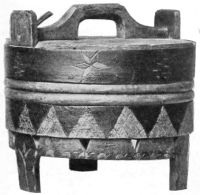
Wooden tub or porringer, from Småland, Sweden. Painted decoration.

The Swedish container in the black and white picture is called a porringer (cooked food container) in a book by Charles Holme, who travelled to many parts of Europe to study, photograph, and write about “Peasant Art” – what we would call folk art now. It’s hard to know how much information he gathered about the everyday use of the items he studied. He was an art journal editor whose main interest was design.

As far as I can tell without knowing the language, the Norwegian name smøramber for these is closer to butter tub than to butter mould. Smør means butter. Amber doesn’t seem to be a common word in Norwegian. Interestingly, in medieval England an amber was a “vessel with one handle”, according to the Oxford English Dictionary, and also a measure of liquid and dry weight. And while we’re looking at words, the dictionary says a porringer is a “a small bowl or basin, typically with a handle, used for soup, stews, or similar dishes.”

Photos

Photographers credited in captions. Links to originals: Colour photos by Rolf Steinar Bergli here and here. More picture info here
//
http://pagead2.googlesyndication.com/pagead/show_ads.js

Games tables

games and cards table 18th century
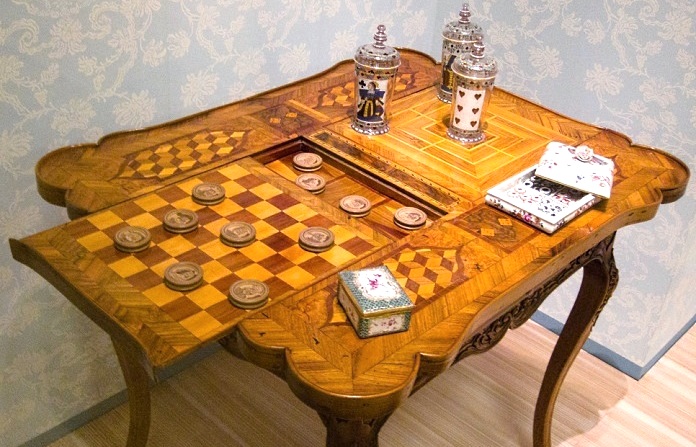
Table from around 1750 has a backgammon board under a chess/checkers/draughts board, and nine men's morris at the other end. Probably German. Photo by Thomas Quine

This table is a fine example of the 18th century fashion for specialised furniture designed to suit particular interests and hobbies. It’s beautifully crafted by a skilled cabinet-maker for a client with plenty of money. Look at the inlay work in the games boards, the edgings, the pairs of dice – and all over. Set in the walnut surface are maple, plum, mahogany and other woods, expertly cut and fitted together.

The later 1700s saw more and more furniture created exclusively for people’s leisure activities. Clever metamorphic step-chairs for private libraries, and card tables for the drawing-room are two examples I’ve already written about. Ladies’ (needle)work tables were surprisingly often combined with chess boards, and are sometimes as elaborate and decorative as the games table shown here. Stylish, ingenious pieces of furniture suited the mood of the times.

Georgian games table
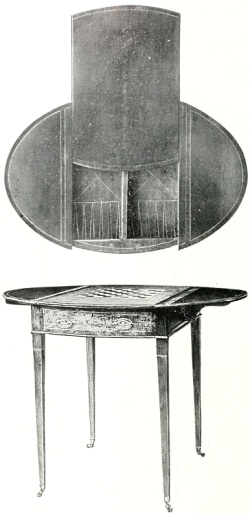
Mahogany games table with inlaid chess board. View from side and above showing sliding, reversible top and backgammon layout beneath. English, c1795

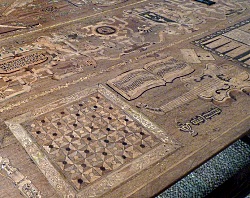
Games boards can be seen occasionally on earlier furniture, like the amazing 16th century “Eglantine” table covered with fine marquetry at Hardwick Hall, England. (Detail pictured below.) But the 18th century brought something new. The table to the right is not as fine as the one in the main picture, but it is probably more typical:

The top is inlaid as a chessboard on the under side, and is made to slide in grooves and to be reversible when required. The top when removed discloses two compartments fitted for backgammon. This game is one of considerable antiquity in England, and was generally referred to as “the tables”. Although now relegated to country vicarages and the homes of the smaller squirearchy, it was a fashionable amusement during the eighteenth century, and one at which considerable sums were won and lost by the “bucks” of the Georgian period and the days of the Regency.
Herbert Cecsinsky, English Furniture of the Eighteenth Century, 1909

Porcelain, and more table details

The bigger porcelain box on the table at the top of the page is for game tokens or counters, and was made by Meissen, probably between 1750 and 1780. The little green one is a Meissen snuff box made c1745.  Inside the lid (sorry, not visible) is a scene of people playing tric-trac, a kind of backgammon. The glass beakers with playing card decoration are the oldest things in sight; they come from early 1700s Saxony.

16th century table
Chess and backgammon boards inlaid in 16th century Hardwick Hall table. Photo by Damian Entwistle

The German table, in the Deutsches Historisches Museum, is approx. 35 by 29 inches, and 29 inches high. The English Georgian table is 28 and a half inches high. The top is only 20 by 22 inches when the side flaps are down. When up, they rest on hinged supports, and make the table’s full length 39 inches.

Photos

Photographers credited in captions. Links to originals here: Games table, Hardwick Hall table. More picture info here

//
http://pagead2.googlesyndication.com/pagead/show_ads.js


Card tables and a social life

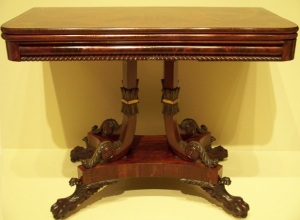
American mahogany card table with gold touches. Hinged top opens out to about 36in. square. c1828. Photo by Jenny O'Donnell

Many finely-crafted card tables were made in the 1700s and 1800s. The social lives of prosperous families in America, Britain, and other parts of Europe depended on having a card table, or two, for friends to play at in the evening.

Before 1700, card-playing was popular with very rich people, and less so with people who were moderately wealthy. It stayed fashionable with the aristocracy in 18th century Europe. Wealthy gamblers sometimes lost huge sums of money in gaming houses or private mansions where a ‘banker’ oversaw games of chance like faro or basset.

During the 1700s and 1800s more people came to have more leisure time, and they furnished their homes to reflect this. Comfortably-off hosts in middle-sized houses organised card tables for their evening guests. People still played for money but the games, like whist or piquet, involved more skill and less betting. The players might enjoy conversation more than cards once a nice little group was gathered round the table. This often provides a useful scenario for dialogue in novels. Young women confide secrets over cards in Jane Austen’s Sense and Sensibility, and older ladies whisper animatedly at Cranford card tables described by Elizabeth Gaskell.

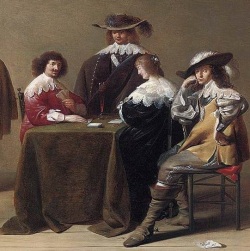
Playing cards c1637. By Dutch painter Jan Olis

Before it became fashionable to have special furniture crafted by cabinet-makers, cards were often played at tables covered in a floor-length cloth, as you can see in various paintings of elegant 17th century players. Artists also show poorer card players, usually men, gathered round a stool or barrel when they had time for card playing.

Decorative or simple?

Early 19th century Empire or Regency tables, and later Federal Era tables in the USA, generally had fold-over tops concealing a playing surface, which might be covered in green baize. Carved pedestal bases had legs that could swing out to support the square opened top. Mahogany was a popular choice, but walnut, maple, rosewood or satinwood were also used.

pair neo-classical card tables
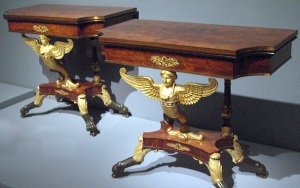
Card tables made in New York by Frenchman Lannuier c1817. Photo by Peter Roan

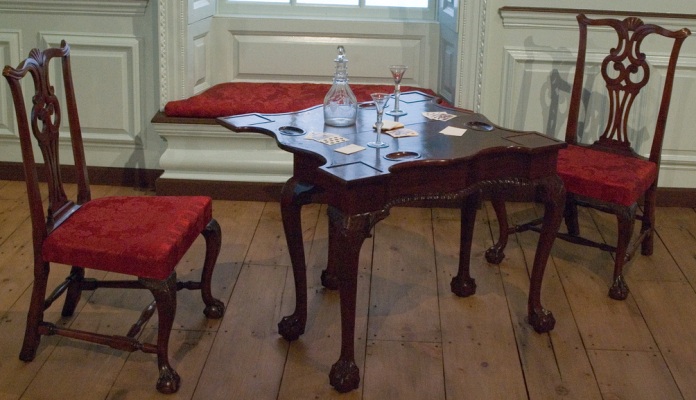
Ornamentation varied. Later card tables tended to have more elaborate flourishes than the relatively restrained pre-1800 designs. A semi-circular or demi-lune Georgian flip-top table might have simple tapered legs. Inlaid surface patterns were likely to be discreet geometric designs. Whether the top folded into a rectangle or semi-circle, a typical card table was about 30 inches high and 36 inches across: a good size for four people to chat as well as play. Some tables were made with recessed holders for coins or tokens. (See big picture below.)

In Victorian times social card playing was by no means only for the grandest section of society. A card table was almost essential for households aspiring to a middle-class way of life. An 1856 book* advising British people how to set up house on annual budgets of £100 upward assumed there would be a card table in the drawing room, even if it was only mahogany veneer on a softwood frame, with a simple round or square top.

By this time a particular style of simple oval or round table was known as a ‘loo table’. Loo, or lanterloo, was a popular game in the Victorian era, though its origins are  older. Sometimes these tables had a tilting top (not folding in half), perhaps with inlaid veneer decoration, and so they could be kept upright by a wall.

18th century American card table
Card table, top open, Queen Anne legs, in the Robert Hooper House, built in Massachusetts c1754. Photo by Jonathan Dresner

There were always a few people who kept away from card playing for religious or moral reasons – but not always the ones you would expect. In George Eliot’s Middlemarch there’s a clergyman who plays cards well enough to pad out his modest income with regular winnings, though he attracts disapproval from some of his neighbours.

*JH Walsh, A Manual of Domestic Economy: suited to families spending from £100 to £1000, London 1856

More on American card tables influenced by cabinet-makers like Sheraton in Philadelphia Empire Furniture by Allison Boor

Photos

Photographers credited in captions. Links to originals here: first mahogany table, Hooper table, pair of tables. More picture info here

//
http://pagead2.googlesyndication.com/pagead/show_ads.js