Rag rugs – hand-made craft in an industrial age

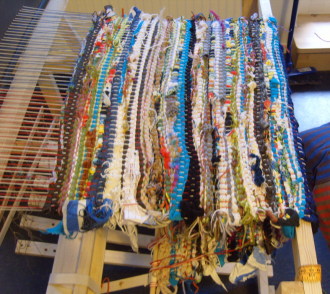
rag rug woven on loom
Rag rug made with strips of cloth woven into warp threads on a loom. Photo by Travis Meinolf

Rugs made from strips of cloth existed well before factories began producing cheap fabric, but not in anything like the same quantity. Even in quite poor households, rag bags of the 1800s were filling up with old clothes and scraps left over from dress-making. In the factories, there were clippings and oddments to be sold off cheaply or swept up by employees. Cotton feedsacks gradually became available too. Rag rugs created from scraps on a woven background (the second and last kinds in the list below) could use old jute sacking or cheap burlap as a foundation. These materials were easily available in many parts of North America and Europe by the middle of the 19th century. With time, and a little skill, families could warm and decorate their floors.

By 1900, some rag rugs were less about thrift, and more about craft. There was a movement towards careful design, and more elaborate techniques, and craftswomen started to buy and/or dye fabric with particular patterns in mind. This interest in rug-making as an aesthetic craft was stronger in the US than in the UK, where rag rugs were mainly seen as an economical choice for poorer homes until the mid-20th century. While Britain tended to dismiss rag rugs as “working-class”, American county fairs and exhibitions offered prizes for rag rugs alongside patchwork quilts and other textile arts.
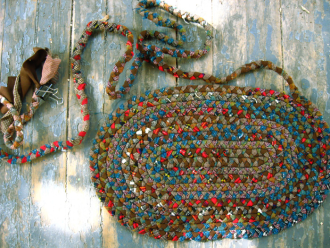
braided rug
Cloth strips are braided. The braid is coiled round, secured with stitching, to make this oval rug. Photo by Jodi Green

There are many varied ways of making cloth remnants or “rags” into floor coverings, but this is a brief outline of the types known in the Victorian era.

  • Rugs woven on a loom: perhaps a linen warp thread with wool or linen strips used for the weft. These are probably the oldest kind. “List carpets” in 18th century England and colonial America were one of the cheapest kinds of soft floor covering. Sometimes woven lengths were sewn together to create rag carpeting.
  • Rugs made with cloth scraps looped through a loosely-woven canvas or burlap background. The rags can be hooked through from the upper side or poked through from underneath, creating varying surface textures from smooth to tufted. Implements for hooking or prodding ranged from home-made wooden pegs to factory-manufactured latch-hooks.
  • Rugs made by coiling joined-up lengths of rag. The coils of braided rugs, or mats made from fabric-covered cord were fastened with thread stitching or binding; crocheted versions need no sewing.
  • Knitted or crocheted rugs made in one flat piece.
  • Rugs, often small door-mats, made by stitching scraps onto backing material. Tongue mat is one name for these, based on the tongue-shaped pieces used in one popular design.
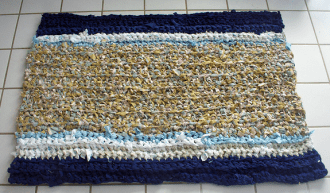
Rug crocheted from fabric scraps, making a 47 x 32 inch rectangle. Photo by Bethany.

Note: The UK had a large number of different regional names for the rugs in the second category, like clootie, proggy, proddy, clippy, stobbie or peggie rugs or mats. These now seem very attractive, admired for craft, design, and nostalgia reasons, but they were not appreciated by the wealthier classes in the 19th century.

Photos

Photographers credited in captions. Links to originals here:
loom rug, coiled rug, crocheted rectangular rug. More picture info here

//
http://pagead2.googlesyndication.com/pagead/show_ads.js

Fluting machines, ruffles, and the Dudley fluter

dudley fluting machine
The Dudley Fluter - a fluting machine patented by Charles F. Dudley of Lockport NY. Photo © George Short, Campton, NH.

Once in a while a reader sends me a splendid picture of a charming object. This fluting machine photograph came from George Short, and it made me curious about who, why, what, and where.  George told me it was patented in 1876, a time when fluted ruffles were a fashionable trimming for ladies’ clothing. He also knew the inventor was Charles F. Dudley, but who was Dudley?

In the 1870s dressmakers were using pleated frills, also called fluting, lavishly. Dressmakers and classy laundries offering “fancy” ironing services both had plenty of use for a fluting machine. Fluters were sold for home use too. Classified ads from the 1860s to the end of the century show employers looking for a laundress who “thoroughly understands fluting”, or women claiming they could “do all kinds of fine laundry work, pleating, French fluting, starching, and polishing”.

So how did you heat the ridged rollers that pressed rows of fluting? You couldn’t really heat them on the stove as you did with flat irons for general ironing. Instead you heated a stick, called a heating iron, that went into the hollow interior of the roller: by letter ‘d’, Fig. 2 in the drawing below. These 19th century machines made pressing frills easier than it had been before.

Inventor and manufacturer

fluting machine patent drawings
Dudley's 1876 patent showing his unique design for the lower roller: a piece cut away (at K) for the easier "introduction of the heating-iron" into the "cylindrical chamber".

The Dudley Fluter was invented by the owner of a foundry in Niagara County, NY. Charles F. Dudley was born in Lockport, and aged about 31 when he got his 1876 patent for “an improvement in fluting-machines”, when fluted ruffles were the height of fashion. He had started his working life as a moulder making moulds for casting metal objects.

He lived with his wife Alice just a few miles from the border with Canada where his mother Sophia was born, and ran a foundry in a small town. What did he do about marketing his invention? There were already plenty of other fluting machines available to cope with the fashion of the times. Dudley’s machine had a couple of small details which made it unique – and earned it the patent. The floral version is distinctive, and must have cost more than the plain kind with a smaller base.

We know both styles – plain and decorative – were manufactured as they occasionally come up in antiques auctions, but there is not much mention from their own era. In 1881 a “large size” of Dudley fluting machine was advertised in the Utica NY Morning Herald at $3.90. Along with other branded fluting machines, sad irons, and wringers it was available at H. Beckwith’s Old Stand in Genesee Street. The patent itself had been listed in the Hudson Evening Register soon after it was issued.

I can’t help feeling there is more to discover about Charles F. Dudley and his fluting machine. For instance, there are clues that he may have moved to North Tonawanda, NY, also in Niagara County. Do please add something in the comments section below if you know more.

fluted frills and ruffles 1870
Aspirational fashion picture showing dresses with fluted trimmings. In Godey's magazine for August 1870
Photos

Photographer for Dudley’s fluting machine is George Short of Campton, New Hampshire, who kindly granted permission for his picture to be published here. He retains all rights in his work so please note that you cannot reproduce it without permission. The Godey’s picture was found on this historical fashion site.

http://pagead2.googlesyndication.com/pagead/show_ads.js

Historic kitchens – visiting with eyes wide open

16th century kitchen fireplace - Tudor England
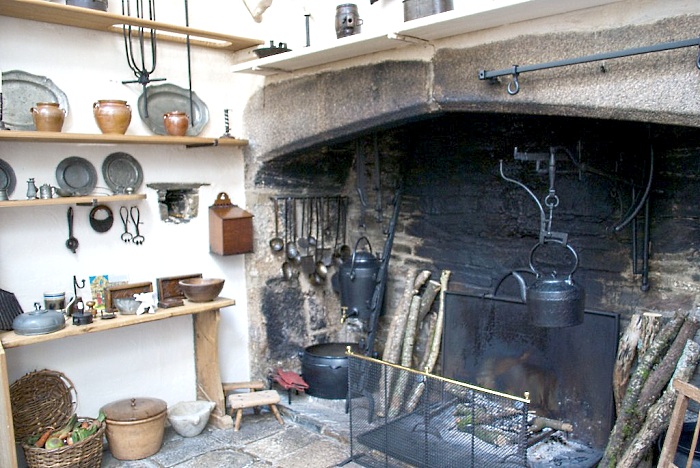
Open fireplace 10ft across in the 16th century kitchen at Cotehele House, Cornwall, England. See how many things you recognise before reading lower down the page. Photo by Lee Morgan.

Whenever I travel I look out for historic houses, especially if they have kitchens worth visiting, and enjoy picking out bits and pieces for a closer look.

And yet the room often isn’t the way it would have looked at any time in its life. The picture above is of a 16th century English manor house kitchen, amazingly unchanged in its basic structure. The Tudor open hearth with old iron pots and logs in a smoke-blackened fireplace is wonderful, but when did that protective fireguard appear? The things on the shelves come from various different periods in the life of the house. When and where did each pot, plate, or tool start its useful life? Does knowing matter? For myself, I enjoy seeing a kaleidoscope of things that have belonged to the house over the generations – but it’s still good to know what’s what.*

What can you identify in the picture?

Ironware

In the fireplace the classic iron kettle hanging on a chimney crane is centuries-old way of heating water. The crane may have arrived in the kitchen in the 17th or 18th century to replace a simpler kind of hanger. There’s also an “idleback” kettle tilter to help with pouring, probably not there originally. The urn to the left has a brass tap that may be relatively modern. The assorted spoons, ladles, and skimmers look timeless; you’d have to examine them hands-on to try guessing their dates. A trivet sits under the red cloth. Out of sight above the mantel-shelf are racks for roasting spits, and a cradle-spit for roasting small birds or joints of meat is hanging down into the upper left of the picture. Many big kitchens acquired fancier mechanised roasting equipment and cooking ranges or stoves well before 1900, but I understand this room was in use, unmodernised, until 1946. (There’s an old oven in one of the walls you can’t see.)

Kitchen utensils 1900s
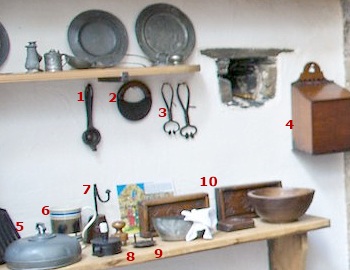
Selected utensils have been numbered to help with the discussion. Some are probably 19th century like the mug, and others could be much earlier, e.g. the pewter plates.

Smaller iron things on the shelves and nearby include two pairs of sugar cutters (3), a rushlight holder (7), lemon squeezer (1), and vegetable cutter (2) – suitable for hacking up root vegetables and big cabbages.

Woodware

A wooden salt box (4) hanging to the left of the fireplace has a traditional sloping lid and carved hanging loop. On the shelf below is a nice turned bowl. The two flat moulds with decorative carving (10) have left me wondering. Are they unusually long, flat butter moulds, or an uncommon kind of gingerbread mould with sides, or something else?

Biscuit pricker

The small wooden stamp with a round handle (8) is a biscuit pricker. With lots of little needles on the base, it was used before baking to perforate the dough for thin crackers, to help them stay flat in the oven. Think of it when you see the holes in British water biscuits or American graham crackers. The metal stamp (9) is probably a cookie cutter or biscuit docker: for cutting out small baked goods and possibly adding a pattern.

Water Biscuits: Into one pound of flour rub three ounces of butter, add a sufficient quantity of water to make it a stiff dough; well knead it, and roll it as thin as wafers; prick with a biscuit-pricker, and bake a very pale brown. (1870s UK recipe)

Other things

On the shelves are pewter plates and a metal cloche or dish-cover (5) that looks factory-made. The earthenware mug (6) is mocha ware, almost certainly for beer. This design with coloured bands and black-brown “trees” first appeared in the very late 18th century and was often seen in 19th century pubs where it might be government-certified as a pint or half-pint measure. Similar earthenware mugs were also used for the servants’ ale in big houses.†

On the floor, next to the big unglazed ceramic storage pot with lid, is a stone mortar without its pestle. It has those familiar triangular bits round the upper edge, but what are they for?  The hole in the wall is the kind that might be used as a candle and rushlight store: handily near the fire for lighting.

More

If you like to ID old kitchen items, try the things in a 1920s ranch kitchen or a German kitchen around 1930.

Notes

*Please note these are general remarks about all sorts of places, and are not in any way a criticism.

†See Pamela Sambrook’s Country House Brewing in England.

You may be interested in this list of links to sites that help you research kitchen antiques and historic culinary utensils.

Also see this piece about where a butter worker belongs. Was it always in the kitchen?

Photos

Photographers credited in captions. This is the original kitchen photo, or see more picture info here.

//
http://pagead2.googlesyndication.com/pagead/show_ads.js

Cornishware: what did people like about it?

Cornish ware jar jugs
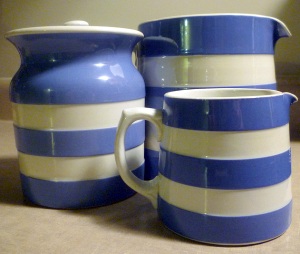
Classic blue and white Cornishware jugs and storage jar. Photo by Mary-Kay G.

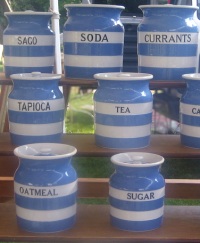
Why did Cornishware appeal to people in its early days? Now we think of it as a British “design classic”, collected above all for its distinctive broad blue and white stripes, the core pattern of the original TG Green Cornish Kitchen Ware range. Some collectors also like less common variations: black stripes, or a storage jar lettered with the name of a retro cooking ingredient.

The blue and white banding has always been the most popular design. Did it really suggest white-crested waves under a blue sky to its early customers, as the company now believes? Cornish seascapes inspired the brand name, but people often associated it more with cottage and farm kitchens than with the wide open sea.

Cornish blue storage jars in ad
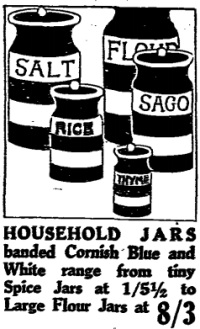
1941 UK ad for banded Cornish Blue and White kitchen jars. Different sizes, different prices.

The term Cornish was a marketing strategy used to evoke farmhouse and country associations, while the use of blue reinforced the fresh feel of the dairy.
Catherine McDermott, Design Museum Book of Twentieth Century Design, 1999

In 1932 the Manchester Guardian wrote about “Cornish farmhouse-ware, with its bold blue lines and white background”.  A few years later one of its writers said you might get some at a “cottage sale” or “the village store”.

Cornishware was available in Canada in its early years, and there too it seemed like homey kind of stuff. When a new batch arrived in British Columbia after the second world war, an ad in the Vancouver Sun called it “lovely wholesome famous blue and white ware”.

In 1957 a New York store offered “peasant-type Cornishware earthenware, cherished for its rugged good looks.” It still had a pleasantly down-to-earth image for a New Yorker writer twenty years later:

… nice English Cornishware whose wide blue and off-white horizontal stripes have such an air of cheerful comfortableness …

Cornish blue plates covered dish
Cornishware covered butter dish and plates. Photo by Robin Kearney.

Was it always intended to have a folksy appeal, for people wanting to make their kitchen or breakfast table look cosy and rural? Maybe not. The colour was originally called electric blue, or “e blue”, which sounds more contemporary than rustic. And Catherine McDermott, professor of design, links the style to Modernism as well as to farmhouses and dairies:

Cornishware’s distinctive blue and white bands owe something to the Continental development of well- designed, mass-produced Modernist tableware at this time.

Cornishware storage jars
Sago and tapioca look good in Cornishware lidded jars, but does anyone cook sago or tapioca pudding today? Photo by Katy Frankel.

So how do you react? Does Cornishware make you think of ocean waves, wholesome farm kitchens, or modernist electric blue?

Note

I haven’t tried to distinguish between genuine TG Green Cornishware and imitations here, with the main focus on discussing the way people feel about the Cornish Blue style.

One 1930 ad offered a Cornish Ware tangerine-and-white version which I haven’t come across elsewhere. Orange was available at some point, but was it made by TG Green in 1930?

Cornish Ware
…It’s available now in green-and-white or tangerine-and-white, as well as in the blue-and-white that everybody likes. The whole range is reduced for this event – plates, basins, store-jars, everything, as an example, you can have a sturdy two-pint milk jug for 2/9
Ad for Lewis’s Household Bargains Event, Feb 1930, Manchester Guardian

Photos

Photographers credited in captions. Links to originals and/or licenses: Jugs and jar, plates and butter dish, storage jars, or see more picture info here.

//
http://pagead2.googlesyndication.com/pagead/show_ads.js

Muff warmers & other antique hand warmers

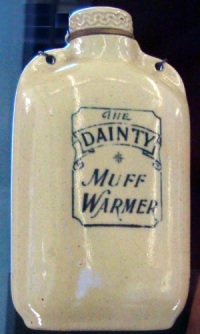
antique muff or hand warmer
Small stoneware hot water bottle to fit inside a fur muff, c1910. Made by S. Maw, Son, & Sons in London. Photo by HomeThingsPast.

A hundred years ago a woman going out in the cold of winter could tuck a miniature hot water bottle inside her fur muff to keep her hands warm: like Maw’s Dainty Muff Warmer in the photo. This kind of hand warmer was on sale in late Victorian and Edwardian England.

The Thermos Hot-water Muff Warmer is a delightful little invention which is sure to be appreciated by my readers.
Ada Ballin, Womanhood, 1904

Poorer people had to find simpler ways of coping with a cold journey: heated stones or potatoes in a pocket, perhaps.

Ma slipped piping hot baked potatoes into their pockets to keep their fingers warm, Aunt Eliza’s flatirons were hot on the stove, ready to put at their feet in the sled. The blankets and the quilts and the buffalo robes were warmed, …
Laura Ingalls Wilder, Little House in the Big Woods (story of the early 1870s in Wisconsin)

The branded stoneware muff warmer was a new take on elegant ceramic or silver hand warmers that ladies’ maids filled when their mistress was about to set out on a cold carriage ride or walk. With carrying strings and tight stoppers, and optional fabric cover, these were clearly designed for people going out from home.

Hand warmers indoors

earthenware brazier or hand warmer
Dutchwoman covers her hands with her skirt to warm them over a terracotta pan of glowing coals c1650. Detail of painting by Caesar van Everdingen.

Hands could be cold indoors too. Plenty of people made good use of a hand warmer in a room or workshop with neither fireplace nor stove. Most parts of Europe had a variety of portable warmth providers, from silver braziers to ceramic novelties to heat-retaining bricks.

An earthenware pot with glowing charcoal was a common source of portable heat. It might be put on the floor, used as local heating or as a foot warmer, but it could also be raised up to warm someone’s hands -as in the picture. At night it could be used in a bed wagon.

Portable containers for hot water or glowing embers are sometimes called hand warmers even when they are used for more than just cold hands.

Pocket warmers

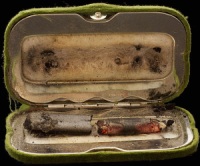
Neat little hinged cases with sticks of charcoal inside were in use in Europe by the first world war, when some officers carried pocket warmers. Someone patented a design in the US for a similar case holding heated metal slugs but I don’t know if these were ever made. There were also tubes to hold charcoal rods.

Pocket hand warmer. Probably early 20th century German. Photo by Matthias Kabel.

One of the newest inventions for winter comfort is a small hand warmer consisting of a hollow cylinder of fiber. A small pencil of heated charcoal is inserted through one end. The device will keep warm … for two hours.
Popular Science, USA, 1924

Chinese & Japanese handwarmers

You can’t really discuss antique handwarmers without mentioning the traditions of Eastern Asia.

Japanese hand warmer
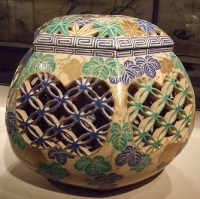
Ceramic te-aburi hand warmer, Japan, 19th century. Photo by Mary Harrsch.

Japanese homes might offer guests a small roundish ceramic pot with fuel in to warm their hands. Called a te-aburi , it could be used by an individual at the same time as a hibachi brazier big enough for a whole group of people.

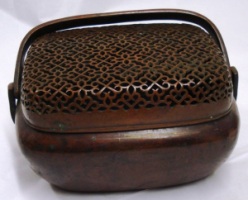
Copper or bronze box-shape hand warmers a few inches across, often with carrying handles, were called shou lu in China: convenient, portable, with glowing coals inside. China and Japan had used both metal and ceramic hand warmers for many centuries. The perforations were an attractive part of the design as well as being functional.  I like this tiny piece of Chinese pottery for warming 7th century hands.

chinese hand warmer
16th or 17th century copper hand warmer, or shou lu, 13.5 cm (5 in) long. A classic Chinese design: box, perforated lid and handle. Photo by the British Museum

European travellers in the later 1800s and early 1900s were interested in the little heaters they saw in the Far East. Some people called them “Japanese muff warmers” and recommended them for nursing and medical purposes. One Englishman bought one for his own winter outings and praised the:

…little stoves which the Japanese women put in their sleeves and obi [wide sash]. They are small enough to push up the sleeve of a [European] coat, and…will keep alight for four or five hours.
Walter Tyndale, Japan and the Japanese, 1910

Hakkin hand warmer
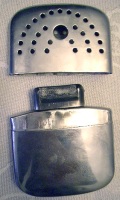
Hakukin-kairo invented in 1923 by Niichi Matoba who founded the Hakkin company. Photo by Pete.

These could be lit with a simple paper fuse in 1910, but it was not long before a modern version of the metal “box” hand warmer was introduced to Japan. It was ignited with platinum catalyst technology. The Hakkin hand warmer or kairo, invented in 1923, looks like a cousin of the cigarette lighter, but I like to think it was inspired by its older ancestors.

S. Maw, Son, & Sons

This English company’s Dainty Muff Warmer was by no means an important product. Maw’s had been dealing in surgical and pharmaceutical supplies from 1807 onwards. One of their early earthenware products was an inhaler (from the 1860s or before). By the early 1900s they were making ceramic foot warmers as well as hand warmers, and also baby feeders, toothpaste pots and more. The company name varied over the years. From 1901-1920 they were S. Maw, Son, & Sons of Aldersgate Street, London.

Photos

Photographers credited in captions. Links to originals and/or licenses:
German pocket warmer, Chinese warmer, Japanese warmer, Hakkin warmer, or see more picture info here.

//
http://pagead2.googlesyndication.com/pagead/show_ads.js

Sock stretchers, stocking airers, and sock blockers

sock stretchers
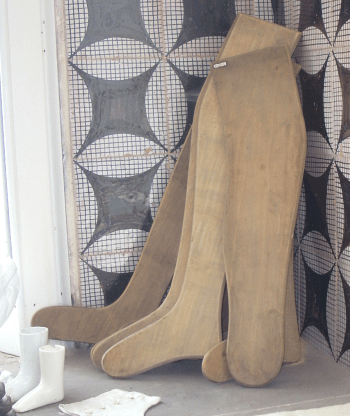
A few wooden stocking stretchers and a pair of unusual small ceramic sock stretchers too. Photo by HomeThingsPast.

In the late 1940s a Canadian housewife, Joan Colborne,† counted her sock stretchers before tackling a backlog of laundry. She “only” had four pairs and so could not wash more than eight woollen socks at a time. If socks were not stretched out while drying they might shrink.

Stretchers like the ones in the photo were the best way of keeping socks and stockings the right size and shape after laundering. If they had holes all over to help air circulate so much the better. The flat wooden legs, clad in long woolly socks, were hung from outdoor clotheslines or given a place to dry indoors.

Since long socks always used to be called stockings, or hose, these wooden leg shapes were originally called stocking stretchers or airers, but the name sock stretchers was more common by the mid-20th century.

They were used by manufacturers as well as at home: an industrial invention with benefits for people doing domestic chores. Hosiery producers sometimes called them stocking boards.

By the time of World War I stretchers seemed so important for sock care that the Red Cross and other people knitting socks for soldiers sometimes sent stocking stretchers along too.

At Caldwell, under the direction of Mr. Howard D. Thayer, a number of stocking stretchers have been made for the soldiers’ use.   (1918 New Jersey School Bulletin)

Wire stretchers

wire sock stretcher patent 19th century
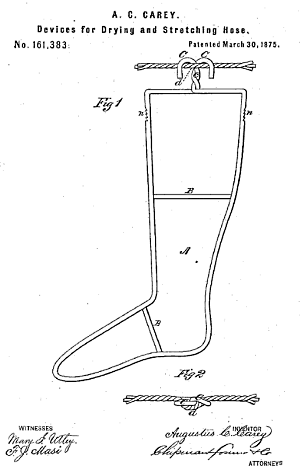
1875 patent for a wire stocking stretcher issued to Augustus C. Carey of Boston MA

Sometimes you see metal sock stretchers made of wire. As long as they were truly rust-free they were probably a better design: more air passing through, and no damp, warped wood. A patent in 1875 seems to be claiming inventor’s rights over the idea of using wire for stocking stretchers, while also patenting other new features in “devices for drying and stretching hose”. The patentee, Augustus C. Carey, was described as “the inventor of more than 100 valuable electrical and mechanical devices” in an obituary.

Although stocking stretchers were certainly used in Britain, especially in big households, it seems that they were most popular in North America. After World War II, when a few more sock stretchers were provided to the troops, there was news of socks that would not shrink. American ads stressed that you could now manage without the hassle of using sock stretchers.

Throw away those annoying sock-stretchers — just wash Sarfert Socks in the usual way. They’ll not only keep their knitted size after many washings, but they’ll wear longer and stay soft and pliant as when new.   (1947 ad)

DuPont nylon will keep their shape, looks, and smartness for a long, long time. Throw away your sock stretchers too because under normal washing conditions these new Bear Brand honeys won’t shrink, won’t stretch, they’ll always fit.   (1949 ad)

children's stockign stretcher ad
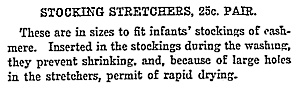
1907 ad for child-size stocking stretchers, to suit soft, luxurious baby socks. Only 25 cents a pair, says the ad in the Daily True American.

Some people still expected sock stretchers to stick around for a long time. In 1948 the Spokane Daily Chronicle published a sceptical column titled Put-up-or-shut-up Policy Issued Against Science?.

As for woolens that won’t shrink, I see that sock stretchers are still being sold…   (Henry McLemore)

Sock blockers

sock blockers
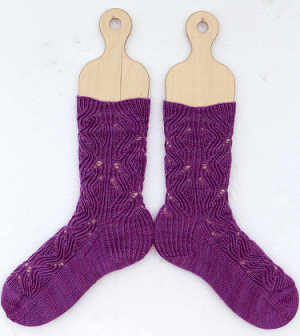
Sock blockers with hand-knitted socks. Photo by ulygan.

Well, that journalist was partly wrong, and partly right. Sock stretchers have come back. A few people use them for wet wool hiking socks, and they’re also popular with knitters, who call them sock blockers. A new generation of hand-knitters use sock blockers to shape up newly-knitted socks. Blocking means encouraging pieces of newly hand-knit fabric to take their intended shape: by dampening, pressing, pinning etc. Sock blockers is a 21st century name for the 2-dimensional wooden legs, although knitters have used “blocking” techniques for longer. I found a couple of mentions of sock blockers before the new millennium, but the name really only took off after the year 2000.

Notes

†See: Joan Colborne, Letters from the Manse, 2003

Photos

Photographers credited in captions. Links to originals and/or licenses: sock blockers by ulygan, or see more picture info here

//
http://pagead2.googlesyndication.com/pagead/show_ads.js

Wedgwood jasperware: solid jasper or jasper dip?

wedgwood jasper cupid psyche 18th century
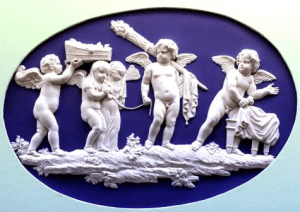
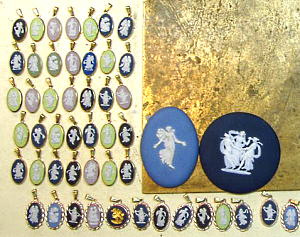
Wedgwood jasperware plaque with Cupid & Psyche marriage from Greek mythology, 1770s. Photo by ego technique.

Jasper dip and solid jasper are two different kinds of Wedgwood jasperware. Both have white classical designs on a coloured background, and look similar to non-experts. If in doubt you are always safe calling this style of pottery jasperware.

Solid jasper came first. After secret experiments in the early 1770s, blending clays with other ingredients, Wedgwood produced a range of hard stoneware with an unglazed, matt blue or slate-coloured finish, and white scenes, figures and motifs in a neo-classical style. Most of the designs were carefully sculpted copies of classical Roman or Greek ceramics – pottery in “antique form” as it was called then.

green jasperware teapot 1790
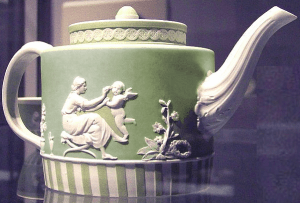
Jasper dip teapot c1790 with relief decoration using a design by Elizabeth Templetown. Photo by Maia C.

The colour was incorporated in the basic mix for solid jasper. This formula was expensive to manufacture and Wedgwood soon developed an alternative – the jasper dip, or surface jasper. This was a way of tinting only the visible surface, leaving backs and insides un-coloured. As well as light Wedgwood blue, colours used for jasper dip during this period included deep blue, lilac, olive, light green, black, pink, and yellow.

White ornamention was made in a mould, then attached to the coloured vases, tableware, portrait medallions etc. This so-called “sprigging” technique was already familiar to potters of the time.

The Cupid and Psyche marriage scene in the first photograph was produced in different sizes, from a small cameo ring to a substantial over-the-fireplace panel. Wedgwood wall plaques in this style fit well into Georgian interiors with white plasterwork ornamenting coloured walls and ceilings.

wedgwood jasperware jewelry brooches
Jasperware cameos - brooches and other small decorative pieces - being made on a 21st century workbench at the Wedgwood pottery in Stoke-on-Trent. Photo by Sunil.

Jasperware was probably Josiah Wedgwood’s most successful creation, imitated by Sèvres and Meissen, and despite going out of fashion for part of the 19th century is still made and appreciated  today. When people say ‘Wedgwood’ or ‘Wedgwood china’ they may well be thinking of this particular kind of pottery with its distinctive white scenes on unglazed colour.

…a fine-grained white stoneware for the ‘sprigs’or bas-reliefs…applied to small background tablets which he coloured blue with a cobalt stain. This blue Jasper has become Wedgwood’s most famous product…
…some had just a ‘blue dip’ because the cost of the cobalt was so high; another, solid Jasper, had the blue colour throughout…
Robert Copeland, Wedgwood Ware

Photos

Photographers credited in captions. Links to originals here:
Cupid and Psyche plaque, teapot, workbench with small jasperware.
More picture info here

//
http://pagead2.googlesyndication.com/pagead/show_ads.js

Love tokens and betrothal gifts carved from wood

carved wooden love spoon
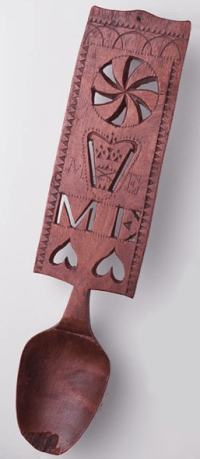
Lovespoon from Wales carved with hearts and initials. Photo from Museum of Wales

I keep coming across nicely carved antiques that were made to be useful, while the decoration shows they were designed as courtship, engagement or marriage gifts. The idea of handmade love tokens is still alive today: especially the tradition of carving love spoons. Craftspeople who make them often use longstanding folk art designs that evolved over time.

Love and commitment gifts developed in pre-industrial communities when craft skills were widespread. Men could work with wood. Women understood textiles and thread. Girls often prepared for marriage by sewing for their beloved, as well as weaving and stitching linens for their future home. Young men made something wooden that would be of value in a woman’s adult life: for instance, a knitting sheath, mangle board, or distaff.

Originally I wanted to make a list of as many different European and North American betrothal or love gift traditions as possible, but even if you limit it to Europe and European immigrant communities in the USA, and limit it to home-made carved wood, or treen, the task is still huge. Still, I’ve made a start below and would enjoy hearing more in the comments.

Lithuanian spinning board and needle
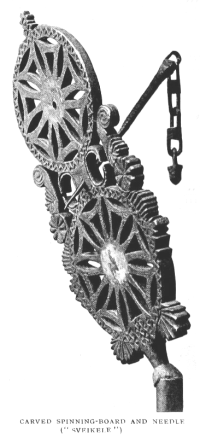
Elaborately carved board with pin is a kind of distaff holding unspun fibre: a characteristic Lithuanian spinning wheel attachment called prieverpste.

Spoons

Spoons have to come first: not only Welsh lovespoons like the one in the picture, but Scottish ladles and pairs of spoons linked by a carved chain, and many other regional types. Chained pairs of spoons are still known as a marriage “ritual” object in Germany. Scoops and spoons sometimes incorporated a freely-moving “caged ball” in the design. Another way of showing off the carver’s skill was to carve all the links from one piece of wood. The single piece of wood may symbolise the marriage union.

Textile tools

Knitting, spinning, and needlework aids which were carved and decorated by loving young men include knitting sheaths, famous in the Yorkshire Dales, lace bobbins, distaffs, and spinning wheel parts like the Lithuanian distaff board in the picture. Pincushions inside a carved box were made by some lovers.

Laundry tools

The Baltic countries, Russia, and parts of eastern Europe have very strong traditions of fine wood carving on the humblest domestic items. This allowed for a wide range of pre-marriage gifts even including decorative washing bats, not very well suited to modern ideas of romance since they’re only ever used for arduous, repetitive routine work. A slightly more glamorous laundry item was the classic Scandinavian engagement gift: a mangle board.

Culinary equipment

gingerbread mold
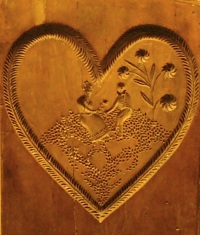
Gingerbread mould from Silesia, Poland. Photo by praccus.

Gingerbread or cookie moulds give lots of scope for personalised carving which will look good twice over: once as an ornament on a shelf and also on home baking at future meals and social gatherings. German springerle moulds are an example. Some butter stamps were carved as love gifts. Other food-related opportunities for betrothal gifts with initials and hearts and anything else you want include rolling pins, salt boxes, and bread boards.

Dress & grooming

Stay busks and combs were once well-liked betrothal or love gifts. Stay busks, worn close to the heart, were for shaping a corset. But they weren’t always wood. Whalebone or scrimshaw busks were carved by British sailors. Some of the most elaborate folk art carving styles in maritime regions developed on long sea voyages, it is often suggested.

The finest gifts

In some regions professional wood-carvers offered a service to young men who wanted to impress their sweetheart or her family. Is this a disappointment?  If I had a wonderful heirloom with my ancestors’ initials on, I would like to think it was home-made, not purchased.

Some gifts chosen by wealthy lovers are obviously not made by amateurs. Spoons and lace bobbins, for example, can be so finely-crafted and elaborate that they stand out from homemade folk art and are clearly the work of expert craftsmen. Other love tokens often commissioned by the privileged classes included combs (in the Renaissance especially) and snuff boxes given to men by women.

Photos

Photographers credited in captions. Links to originals here: Welsh love spoon, gingerbread mould, or see more picture info here.

//
http://pagead2.googlesyndication.com/pagead/show_ads.js

Showers – 19th century luxury and health

antique shower 1890s
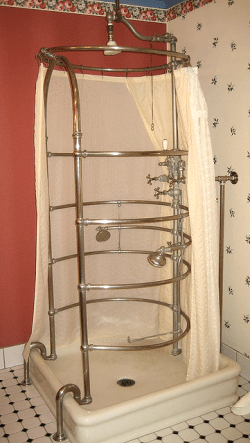
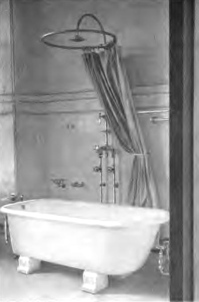
American shower, probably 1890s. Water from above and from the sides, various different settings. Photo by Dan Theurer

The earliest showers were rather like having a pail of water tipped over you from a height. By the 1880s there were some more sophisticated contraptions available. They could be fully integrated with indoor plumbing, and came complete with an array of taps and valves to adjust temperature, water flow, and more. Patent mixers were invented to make sure the water could never be scalding hot. One manufacturer promised their needle shower would not let water go over 98 degrees F (body temperature). Showers were supposed to be invigorating and health-giving, so cool or lukewarm water was considered beneficial.

  • A needle bath or needle shower directed jets of water all round the torso. Sometimes the water flow could be adjusted, and a particular setting was promoted as a liver shower or bath, supposedly offering a stimulating massage for internal organs. Its energising effects were considered more suitable for men than women. Needle showers were marketed to gentlemen’s athletic clubs as well as private houses. Some people call them cage showers.
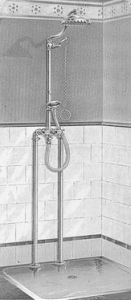
  • A rain bath or shower was an overhead spray coming from a circular head pointing straight down or slightly slanted. Also called a spray bath, it was a desirable fitting for modern, hygienic public baths and hospitals.
  • Combination showers with a variety of features were promoted by leading manufacturers. Some were decorative as well as cleverly designed. They led to the canopy shower.
vintage canopy shower bath
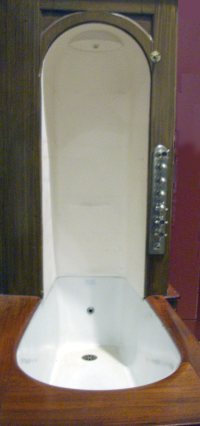
Canopy bath, made in the UK early 1900s. Photo by HomeThingsPast.
  • Canopy showers or canopy baths built several bathing features into a fine piece of furniture. Designed for bathrooms in well-decorated homes, these were available for the well-heeled buyer in North America and Europe in the late 1800s and early 1900s. The porcelain enamel tub extended upward at one end into a tall curved shower wall, usually with a hood. This impressive bathroom centrepiece could be seven feet high. Many were fitted inside dark polished wood cases; some had ornamental enamelled metal exteriors. Douche and plunge settings were sometimes included. The plunge was a gushing flow of water, not a spray or fine jets. Other features of needle or canopy baths could include a kidney, spinal, or bidet spray, or a special shampoo spray.
English needle shower bath
"Improved needle bath" by Smeaton of London, 1890, had 6 rows of needles, each with its own controls. Shower, douche, and sitz were "usually fitted". Patent mixer and thermometer were extra. Upmarket Victorian hotels and aristocratic customers using Smeaton baths and showers are listed in the ad.

UK manufacturers tried to entice wealthy late Victorian customers with a steady supply of new features. As well as all the shower options, you could have fine carving on the canopy bath surround, a curving bath with extra space at the shower end, or an open top “Oriental” bath which avoided any “sense of confinement”. Instead of being enclosed in dark wood, the Oriental model was metal decorated with stencilled friezes, fluted columns, and cornices. Copper and other metal canopies came into vogue, and started to replace the heavy mahogany look.

When did ordinary homes get showers?

Around 1900 these were splendid luxuries for rich people, who often bought them for the supposed health benefits of special kinds of bathing. A lot of routine hygiene depended on washstands and hip baths in the bedroom. But when were showers fitted in middle-class homes?  There are plenty of statistics about the percentage of homes in various countries with either a bath or a shower, but very little about showers alone.

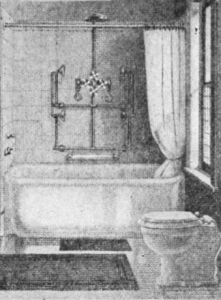
The 1920s was when showers began to spread to “normal” homes in the USA, especially new homes, according to many writers.† The pictures at the bottom of the page give a foretaste of this, with US bathroom designers illustrating not-too-lavish bathrooms with showers included. Sears Roebuck was selling showers by 1915. By 1965 a study of one thousand American middle-class homes found that 85% had both a tub and a shower.*

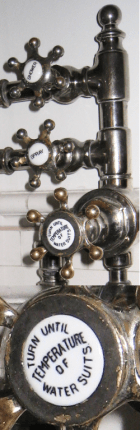
"Turn until temperature of water suits." Faucets on needle shower in Seattle, c1914, with enlargement of one. Photo by Michael Cornelius.

Even though British shower manufacturers and wealthy customers had kept pace with American developments up to WWI, it stopped there. Bathrooms were different on different sides of the Atlantic. Showers appeared in sports clubs and other communal facilities but remained uncommon in private homes in Britain before the 1970s/80s. (Sorry, only anecdotal evidence so far, but I’m pretty sure.)

Many European countries were far slower than the USA to adopt showering at home. Possible reasons include older housing stock without space for showers, and progressive attitudes to new technology in America. Attitudes to hygiene varied from culture to culture.  Sweden was one of the first European countries to take home showers to its heart. 1980s studies in Sweden and Minnesota showed that in both places most homes had a shower and a bathtub.‡

Photos

Photographers credited in captions. Links to originals here:
American needle shower, shower controls.
More picture info here

Notes

†For example, Old House Magazine, Nov 1994
*Marilyn Langford, Personal hygiene attitudes and practices in 1000 middleclass households, Cornell University, 1965
‡Rita J. Erickson, Paper or plastic?: energy, environment, and consumerism in Sweden and America, 1997
Also see:
Katherine Ashenburg, The Dirt on Clean: An Unsanitized History
David Eveleigh, Bogs, Baths, and Basins: The Story of Domestic Sanitation

Porcelain and enamel are two different names for the same glazed coating on iron baths: usually white but not always.

shower 1880s
1888 - nickel-plated brass shower with shampoo pipe, for athletic club rooms, or for fitting over a bath. Curtain ring available as an extra. Ad for Mott of New York.
shower bath 1910
Shower c1910 over bath. Porcelain enamel on iron tub. Curtain could be thick cotton or silk lined with rubber. USA.
needle shower tub 1916
c1916 - Mott's combined "needle and rain shower" has foldaway needle "arms" that the user can swing forward when required.

//
http://pagead2.googlesyndication.com/pagead/show_ads.js

Boot scrapers

painted boot scraper
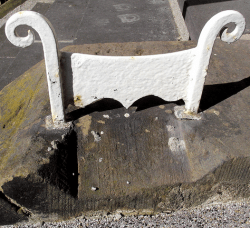
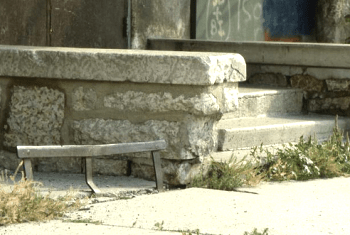
Simple scraper at Münster prison, Germany. Photo by Dave.

Who uses boot scrapers in the 21st century? Portable ones are on sale for gardeners, and for anyone else who wants to tackle muddy boots before approaching clean houses, cars, or paths. But the days of iron scrapers being placed at every door are over. The finest ornamental 19th century scrapers are still there beside elegant townhouses and country mansions. Scrapers have stayed on some smaller homes, especially where the scraper is embedded in the wall. Plain, functional scrapers sometimes remain by historic buildings.

Gone are the days of architects and builders planning for boot scrapers:

English boot scraper arch shape
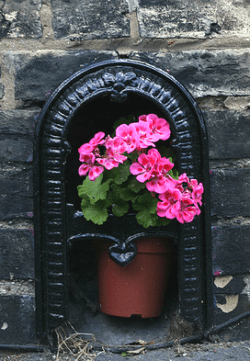
Arch framing scraper set into wall - a design once used widely in England. This one is in Cambridge. Photo by Nick James.

Scrapers for the feet may be let into the wall of the cottage, on each side of the door, a cavity being left over the scraper for the foot, and one under it for the dirt. There are various forms of scrapers for building into walls, which may be had of every ironmonger; and all that the cottager has to do is to choose one analogous to the style of his house. There are detached scrapers in endless variety; the most complete are those which have brushes fixed on edge, on each side of the scraper…
An encyclopædia of cottage, farm, and villa architecture and furniture …John Claudius Loudon, London, 1839

Schools no longer put scrapers on their list of essentials:

The Scraper ….. the steps or platform leading to the door ….. either will be incomplete without a strong, convenient shoe scraper at each side. Two will be required, for the reason that the pupils enter the school, morning and afternoon, about the same time, and if there be only one scraper, it will either cause delay or compel some to enter the building with soiled shoes. Cleanliness and neatness are amongst the cardinal virtues of the school-room ; and every means of inculcating and promoting them should receive the earliest and most constant attention.
JG Hodgins, The school house: its architecture, external and internal arrangements, Toronto, 1876

Canadian boot scraper
Old school in Winnipeg, Canada, with a long boot scraper for several children to use at once. Long scrapers were a typical school design. Photo by Per.

What we do have now are enthusiasts who just love old boot scrapers. Since these are often fixed into stone, they are best collected by photographers. One collection is mostly from the UK or US. Another is from Brussels where, says the introduction, scrapers used to be part of the etiquette and ritual for entering both public buildings and individual homes. A Toulouse “collector” has analysed local styles and named them: ram’s horns, fir-cones etc.

boot scraper railings
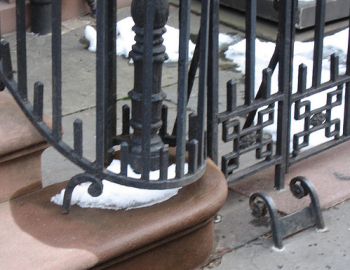
Scraper discreetly set at foot of steps with iron railings in New York. Photo by Kim Navarre.

When did boot scrapers arrive as a normal part of daily life? The first print references start mid-18th century, when they are simply called scrapers.* I haven’t seen any that go back as far as this, but am hoping a “collector” may know of one and add a comment – please. Foot scraper and shoe scraper are terms also used, but boot scraper is far the most common name.

portable boot scraper
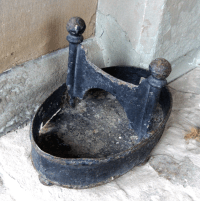
Movable cast iron scraper with tray to catch dirt. Probably late Victorian. Photo by HomeThingsPast.

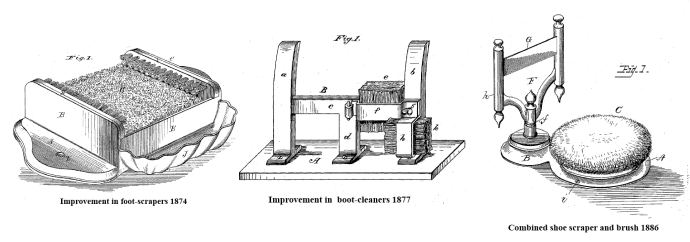
They attracted 19th century inventors with an eye on patenting newer, cleverer kinds of scraper: quite often combined with brushes. Some of these look useful, some don’t, but none has the elegance of the best architect-endorsed scrapers, chosen to suit the house they were protecting from mud. One design that stands out from the crowd is seen in New York  and Savannah, Georgia. By integrating the scraper into the railings it avoids the “afterthought” look of a shoe-cleaner that doesn’t suit the architectural style of the house, but it isn’t quite as obvious as a free-standing scraper. Did visitors know where they were supposed to clean their footwear?

 cast iron scraper in corner
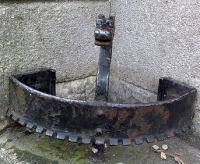
Scraper with dragon head in Oxford on 1882 building. Photo by Barnaby S.

Specification of Works to be done in erecting and completely finishing a Villa….with all the necessary appurtenances [sic]….
Iron-founder…Provide cast-iron strong tray boot scrapers to front and back doorways.
Specification of Works required to be done in erecting and completely finishing a Pair Of Semi-detached Cottages….
Iron-founder….Fit up to each front door a neat iron knocker and a neat iron-pan scraper.
Practical specifications of works executed in architecture, civil and mechanical engineering, London, 1865

boot scrapers 19th century
US boot scraper and brush combinations patented in 1870s and 1880s. Called foot-scraper, boot-cleaner, and shoe scraper, and all portable.
Photos

Photographers credited in captions. Links to originals here:
White boot scraper, school boot scraper, arch scraper, scraper and railings, dragon scraper.
More picture info here

Notes

*Oxford English Dictionary cites Swift’s Directions to Servants 1745

//
http://pagead2.googlesyndication.com/pagead/show_ads.js