Boot scrapers

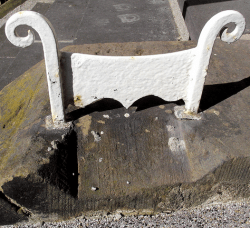
painted boot scraper
Simple scraper at Münster prison, Germany. Photo by Dave.

Who uses boot scrapers in the 21st century? Portable ones are on sale for gardeners, and for anyone else who wants to tackle muddy boots before approaching clean houses, cars, or paths. But the days of iron scrapers being placed at every door are over. The finest ornamental 19th century scrapers are still there beside elegant townhouses and country mansions. Scrapers have stayed on some smaller homes, especially where the scraper is embedded in the wall. Plain, functional scrapers sometimes remain by historic buildings.

Gone are the days of architects and builders planning for boot scrapers:
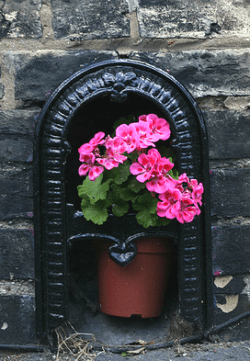
English boot scraper arch shape
Arch framing scraper set into wall - a design once used widely in England. This one is in Cambridge. Photo by Nick James.

Scrapers for the feet may be let into the wall of the cottage, on each side of the door, a cavity being left over the scraper for the foot, and one under it for the dirt. There are various forms of scrapers for building into walls, which may be had of every ironmonger; and all that the cottager has to do is to choose one analogous to the style of his house. There are detached scrapers in endless variety; the most complete are those which have brushes fixed on edge, on each side of the scraper…
An encyclopædia of cottage, farm, and villa architecture and furniture …John Claudius Loudon, London, 1839

Schools no longer put scrapers on their list of essentials:

The Scraper ….. the steps or platform leading to the door ….. either will be incomplete without a strong, convenient shoe scraper at each side. Two will be required, for the reason that the pupils enter the school, morning and afternoon, about the same time, and if there be only one scraper, it will either cause delay or compel some to enter the building with soiled shoes. Cleanliness and neatness are amongst the cardinal virtues of the school-room ; and every means of inculcating and promoting them should receive the earliest and most constant attention.
JG Hodgins, The school house: its architecture, external and internal arrangements, Toronto, 1876
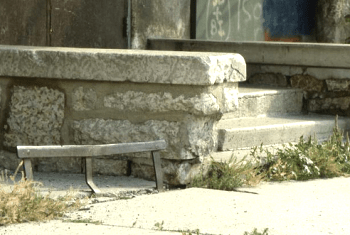
Canadian boot scraper
Old school in Winnipeg, Canada, with a long boot scraper for several children to use at once. Long scrapers were a typical school design. Photo by Per.

What we do have now are enthusiasts who just love old boot scrapers. Since these are often fixed into stone, they are best collected by photographers. One collection is mostly from the UK or US. Another is from Brussels where, says the introduction, scrapers used to be part of the etiquette and ritual for entering both public buildings and individual homes. A Toulouse “collector” has analysed local styles and named them: ram’s horns, fir-cones etc.
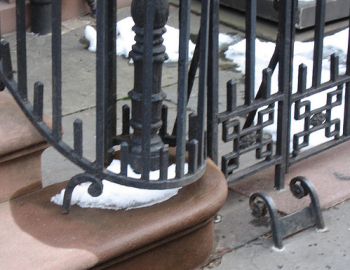
boot scraper railings
Scraper discreetly set at foot of steps with iron railings in New York. Photo by Kim Navarre.

When did boot scrapers arrive as a normal part of daily life? The first print references start mid-18th century, when they are simply called scrapers.* I haven’t seen any that go back as far as this, but am hoping a “collector” may know of one and add a comment – please. Foot scraper and shoe scraper are terms also used, but boot scraper is far the most common name.
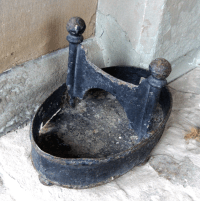
portable boot scraper
Movable cast iron scraper with tray to catch dirt. Probably late Victorian. Photo by HomeThingsPast.

They attracted 19th century inventors with an eye on patenting newer, cleverer kinds of scraper: quite often combined with brushes. Some of these look useful, some don’t, but none has the elegance of the best architect-endorsed scrapers, chosen to suit the house they were protecting from mud. One design that stands out from the crowd is seen in New York  and Savannah, Georgia. By integrating the scraper into the railings it avoids the “afterthought” look of a shoe-cleaner that doesn’t suit the architectural style of the house, but it isn’t quite as obvious as a free-standing scraper. Did visitors know where they were supposed to clean their footwear?
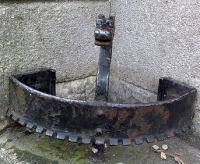
 cast iron scraper in corner
Scraper with dragon head in Oxford on 1882 building. Photo by Barnaby S.

Specification of Works to be done in erecting and completely finishing a Villa….with all the necessary appurtenances [sic]….
Iron-founder…Provide cast-iron strong tray boot scrapers to front and back doorways.
Specification of Works required to be done in erecting and completely finishing a Pair Of Semi-detached Cottages….
Iron-founder….Fit up to each front door a neat iron knocker and a neat iron-pan scraper.
Practical specifications of works executed in architecture, civil and mechanical engineering, London, 1865
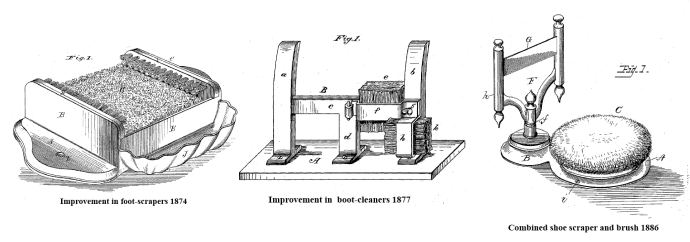
boot scrapers 19th century
US boot scraper and brush combinations patented in 1870s and 1880s. Called foot-scraper, boot-cleaner, and shoe scraper, and all portable.
Photos

Photographers credited in captions. Links to originals here:
White boot scraper, school boot scraper, arch scraper, scraper and railings, dragon scraper.
More picture info here

Notes

*Oxford English Dictionary cites Swift’s Directions to Servants 1745
//
http://pagead2.googlesyndication.com/pagead/show_ads.js

Trundle bed or truckle bed?

trundle bed 18th century
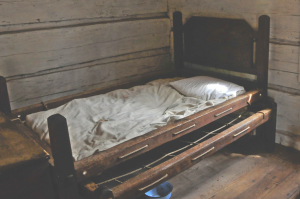
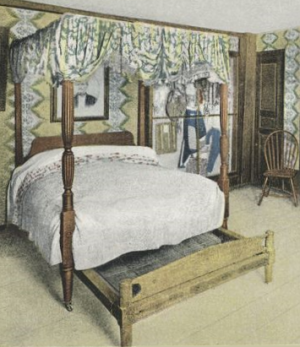
Trundle bed from Massachussetts, late 1700s.

What do trundle beds mean to you? The last one I saw was in a hotel where a small child’s rollaway lived under the main bed in daytime. This is exactly how they were used in thousands of American homes in the 19th century and before. And their history goes back much further too. For some people, trundle beds say “pioneers” or “log cabin” . You come across them in stories evoking that way of life.

By the time the dishes were all wiped and set away, the trundle bed was aired. Then, standing one on each side, Laura and Mary straightened the covers, tucked them in well at the foot and the sides, plumped up the pillows and put them in place. Then Ma pushed the trundle bed into its place under the big bed.
Laura Ingalls Wilder, Little House in the Big Woods

They were certainly used in more prosperous homes too, like the 18th century Lexington MA house in the first picture. Their origins are actually in the grandest homes of all.  Royalty and noblemen used to have a servant sleeping at the foot of the bed. Their high bed draped in fine fabrics easily hid a small, simple rollaway during the day. These rolling or trundling beds probably first came into use in late medieval times.

trundle rope bed
19th century cabin in Georgia with trundle. Both beds strung with rope. Photo by Beneteau Sailor.

Truckle beds are just the same thing by another name. Both truckle and trundle originally meant rollers or castors or little wheely things. There are a few other names around: trumble beds in some parts of the US, hurly beds in Scotland, and sometimes simply rolling beds, or the modern rollaway.

American trundle beds

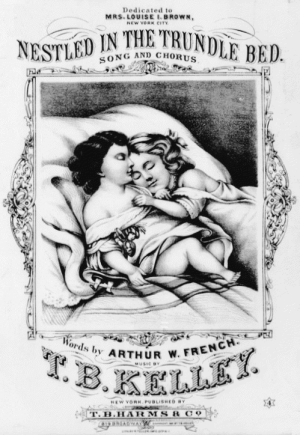
In the log cabin pictured right, both the big and small bed have cords to form a base for the mattress. Mattress covers were filled with corn husks, straw or any suitable plant material that was available, and spread over the rope “netting”. Surprisingly often, songs in the USA of the later 1800s and early 1900s mentioned trundle beds. They evoked a sentimental image of life back home, a cosy childhood with Ma and Pa. (See sheet music below.) But as life got more prosperous for many, with bigger houses, space-saving trundle beds had other meanings too, and some American children from small homes got called “trundle bed trash”.

European trundle beds

trundle bed 1930s
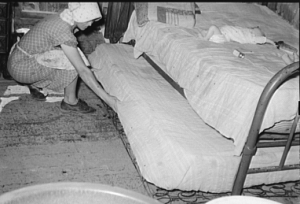
Oklahoma c1939 - trundle bed in a one room cabin occupied by tenant farmers.

In Europe, truckle beds or trundle beds were less likely to summon up visions of a warm, cosy family life. They were rooted in a master or mistress and servant tradition, where it was not at all unusual to have a valet or maid sleeping in a small bed near the big one, ready to be of service when required.

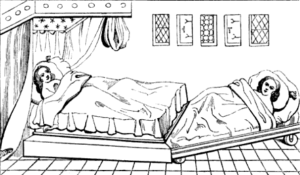
The medieval picture below comes from a French romance where the wife is in the servant’s truckle bed, unbeknownst to her husband, to find out about his goings-on in a story which is more risqué than The Little House on The Prairie. In 17th century London Samuel Pepys’ maidservant slept in the room with both him and his wife, on occasion.

So all to bed. My wife and I in the high bed in our chamber, and Willet in the trundle bed, which she desired to lie in, by us.
Pepys’ Diary, 1667

trundle bed 15th century
Trundle bed for a nobleman's valet. Black and white sketch of illustration in 15th century French manuscript: Roman du Comte d'Artois.
victorian trundle bed
"Nestled in the trundle bed" sheet music with sentimental 19th century picture. USA, 1880s
Photos

Photographers credited in captions. Links to originals here: Rope bed, or see more picture info here

//
http://pagead2.googlesyndication.com/pagead/show_ads.js

Marrow scoops, spoons & table manners

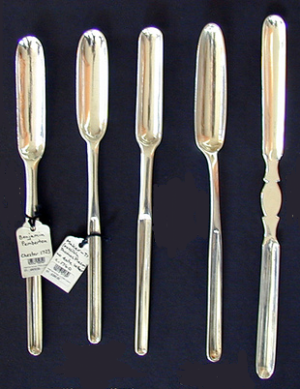
marrow spoons or scoops from 1700s and 1800s
Silver marrow scoops from 1720s to 1850s (left to right). Photo by miladus

A silver marrow scoop is an elegant solution to a problem most of us don’t have today. How can you get the tasty marrow out of meat bones without abandoning your table manners?

Upper class diners adopted new rules of etiquette during the 1600s. Forks appeared on posh tables to help people eat with a less hands-on approach to cooked food. But forks didn’t help take the savoury jelly out of the marrowbones. You can get an idea of how this was done once upon a time by reading a mid-17th century etiquette book. The author thought it best for people to stop handling and “mouthing” bones altogether, but he would allow you to use one hand for meat bones as long as there was no gnawing, sucking, slurping etc. And definitely no banging, cracking, or biting. Get the marrow out neatly and decently – with a knife.

Suck no bones…Take them not with two hands…Gnaw them not…Knock no bones upon thy bread, or trencher, to get out the marrow of them, but get out the marrow with a knife…To speake better…it is not fit to handle bones, and much lesse to mouth them.
Make not use of a knife to breake bones…also breake them not with thy teeth, or other thing, but let them alone.
(Youths [sic] behaviour, trans. from French by Francis Hawkins, 1646)

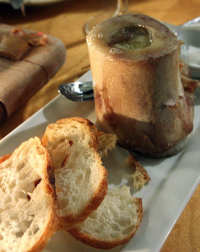
marrowbone served with toast or bread
Cooked marrowbone served with bread. Photo by Sifu Renka

Before the end of the century marrow spoons had arrived, starting in the 1680s. These new implements for eating marrow had a rounded spoon at one end with a narrow scoop at the other. In 1710 one was described as “a marrow spoon with a scoop at the other end”.* Soon the spoon evolved into an elongated scoop, usually with a narrower version at the other end. Many more were made during the 18th century: an era when an impressive variety of new culinary paraphernalia was developed for the prosperous classes – from gravy warmers to caddy spoons.

I wish I could find a written description of someone taking marrow jelly out of a bone in the early days of the new scoops.  Did no-one write about it at all? Later there are recipes for dainty dishes of prepared marrowbone that could be eaten quite easily; by this time the bones were being cut and served in a special way. Diners could still enjoy the traditional delicacy, but without handling the bones at all, not even excavating with a knife as a polite alternative to sucking. Probably the late 19th century marrow scoop in the last picture on this page was intended for this kind of dish. It doesn’t look suitable for fiddly excavation of bones cut from a big joint of meat, or from a whole animal roast on a spit.

marrowbones served Victorian style
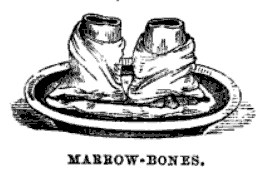
Marrowbones from Mrs. Beeton's recipe

Ingredients.—Bones, a small piece of common paste [pastry], a floured cloth. Mode.— Have the bones neatly sawed into convenient sizes, and cover the ends with a small piece of common crust, made with flour and water. Over this tie a floured cloth, and place them upright in a saucepan of boiling water, taking care there is sufficient to cover the bones. Boil the bones for 2 hours, remove the cloth and paste, and serve them upright on a napkin with dry toast. Many persons clear the marrow from the bones after they are cooked, spread it over a slice of toast, and add a seasoning of pepper; when served in this manner, it must be very expeditiously sent to table, as it so soon gets cold. Marrow-bones may be baked after preparing them as in the preceding recipe; they should be laid in a deep dish, and baked for 2 hours.
(Isabella Beeton’s recipe from 1861)

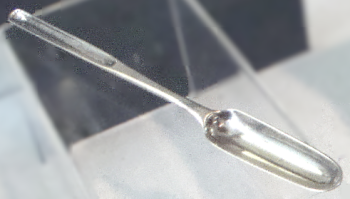
marrow scoop by spoon maker George Smith
Marrow scoop by George Smith - London 1780-1781. Photo by HomeThingsPast

The marrow scoop by George Smith III (picture left) comes from an important company of English spoon makers and silversmiths started by Thomas Chawner. They were active in London from the mid-18th to early 19th centuries.

marrow scoop late 19th C
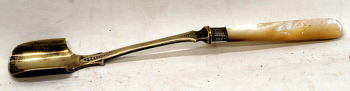
Late Victorian marrow scoop - silver plate, mother of pearl handle. Photo by Leeds Museums and Galleries
Photos

Photographers credited in captions. Links to originals here: 5 marrow spoons – n.b. dates and details on original photo, cooked marrowbone, Gge Smith scoop by HomeThingsPast, Victorian marrow scoop. More picture info here

Notes

* From The Lucubrations of Isaac Bickerstaffe in Joseph Steele’s Tatler: “a marrow spoon with a scoop at the other end”.

See also: a pewter marrow scoop

//
http://pagead2.googlesyndication.com/pagead/show_ads.js

Drying clothes near the ceiling

laundry drying on ceiling rack
Drying clothes indoors in the laundry area of a big historic house in the UK. A high Victorian ceiling leaves plenty of space for this wooden rack with pulley and ropes for raising and lowering. Displayed as it would have looked a century ago.

It’s winter in northern Europe, and there’s no electricity. How can you dry your laundry? One of the best places of all is a laundry room in the servants’ quarters of a mansion house. A generous ceiling height means you can have frames for wet clothes and household linen in the warmest, dryest part of the room. The estate handyman would make them, and by the later 19th century he would probably add ropes and a pulley to raise and lower the rack. No need to climb on a chair to hang laundry.

ceiling clothes drying in swedish peasant home
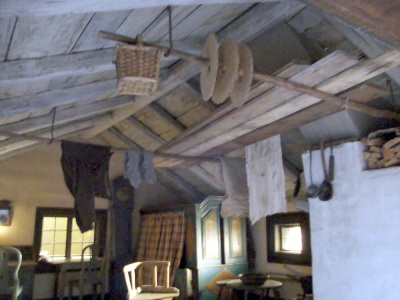
One pole near the roof holds laundry. The other has Swedish hard-bread rings and a basket that needs to be kept dry and airy. From a museum display of Swedish folk life 19th century style.

It was different in a small cottage. With life centred on one room there could be a lot hanging from the ceiling: foodstuffs needing a dry, vermin-free spot, baskets empty or full, medicinal and culinary herbs drying, as well as a steady stream of laundry and clothing soaked by bad weather.

One simple pole attached to roof timbers was better than nothing. Drying washing on frame airers by a fire is effective, but getting some of it up and out of the way is a relief in a small space.

Ceiling clothes pulleys used to be common in the UK, and they are still used in older houses where there is enough height in the room. In ordinary-sized houses they often used to be in the kitchen, so the fresh smell of newly-aired linen might be masked by a vague aroma of cooking. This is the only disadvantage I know of with ceiling drying.

Advantages are obvious. It’s simple. It’s cheap. It uses rising heat that’s wasted otherwise. It’s not much work spreading out the laundry and taking it down later. You can fix racks on lower ceilings if you don’t need the room when you’re drying things.

overhead clothes rack
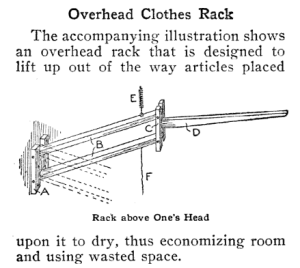
Opening of instructions from 1911, sent in by a Kentucky reader of Popular Mechanics.

Although drying racks on the ceiling were not unknown in American homes of the early 1900s, they seemed to vanish later. But recently they have come back to the USA, perhaps for people interested in saving energy.  You could make one yourself, but you can buy ready-made ones with metal bits imported from the UK, plus US timber. The racks cost a bit more than in Europe, but they are still a practical, environment-friendly way of drying and airing for some people – and money-saving over time.

Clothes Driers vary from the hemp clothes-line, taken down after each drying, copper wires, stretched taut and left out permanently, to revolving driers mounted either on a post in the yard or on a projecting arm from a porch or window. Indoor driers vary from the clothes horse to a rack which is pulled by pulley to the ceiling (very convenient for limited spaces, costing about $5.00).
From: Laundering, by Lydia Ray Balderston, Philadelphia, 1914 & 1923)

An easy way to have your own ceiling clothes airer

The traditional UK pulley clothes dryer is now available in the USA from Amazon.com. There’s a range of sizes and fittings come in different colours. Click the one on the left if you’re in the US. The one on the right comes from Amazon UK.

USA:                               UK:        

Photos

Photos on this page by HomeThingsPast.
More picture info here.

Mrs. Beeton’s pastry essentials

Victorian pastry making tools
Victorian pastry-making equipment suggested by Isabella Beeton in 1861.

Mrs. Beeton knew it took time to learn how to make good pastry, which she called paste.

…the art of paste requires much practice, dexterity and skill…
Isabella Beeton, 1861

Her main tips are:

  • Pastry-making utensils must be kept scrupulously clean and not used for anything else.
  • Use a light touch with cool hands and work in a cool place.
  • Water and/or butter must be mixed in gradually.
  • Tins, dishes etc. must be well buttered.
  • Rich pastry must be put in the oven promptly, as soon as it’s made.

Cooking temperature

Her other tips are all about oven heat and are not relevant to owners of electronically controlled ovens. Just as well, because she uses terms that mean little to us. A raised pie needs a “soaking heat”. Puff pastry won’t rise in an oven that’s too “slack”.

Equipment

After rolling the pastry, ideally on a cool marble slab, you could use corner cutters for a neat finish on a square pie. There were plenty of shaped ornamental cutters available in the 1860s or the wheel on the end of the paste-pincers was good for cutting  pastry shapes freehand. The flutings on the wheel would make a patterned edge like pinking shears do on fabric.

The paste-pincers are for pressing together the edges of the top and bottom of a pie to stick them as firmly as possible. These are new to me and I imagine they could be quite useful. Please do comment if you’ve ever used such a thing.

The picture of the jagger isn’t very clear but it looks like an interesting way of making a decorative edge on pies and tarts: an alternative to pressing edges with the prongs of a fork. The raised pie mould is magnificent but how easy would it be to get the pastry out in good condition? Victorian cooks did work a lot with moulds, including the gorgeous copper jelly and pudding moulds that look so splendid hanging on the walls of historic kitchens, so perhaps they wouldn’t have had any trouble turning out a fine raised pie.

A jagger wasn’t just for pastry. It could also mean a toothed chisel, and other similar tools. We don’t use the word now, though jagged edges are still with us. Jagged suggests something undesirable to me, not really a decorative feature

Mix the eggs with flour…cut them the shape of a long narrow leaf…cut them with a jagger so they will be notched.

from the New York Voice, 1892

She didn’t mention pie funnels.

//
http://pagead2.googlesyndication.com/pagead/show_ads.js

A butter worker in the kitchen?

dasher aka plunger churn
Woman with traditional dasher churn for making butter, around 1905, Wisconsin.

No, not the long-skirted woman. A butter worker is a piece of dairy equipment. But there’s churning and other stuff to do before you use a traditional, non-mechanical butter worker. Scroll down to find a video link if you want to see this right now.

The woman in the photograph has an old-fashioned dasher churn with lid and long handle. It makes butter when someone fills it with cream and then plunges the stick up, down and around. But the end result of churning is not good butter. To begin with, there are lots of little buttery fragments swimming in thin buttermilk. You need to strain these through cloth (like butter muslin) and let the buttermilk drain into a pail.

In the cloth you now have a lump of nearly-ready butter. It’s rinsed to flush out the remaining buttermilk, but it’s still damp and not pure butter in a smooth coherent piece. You may squeeze the lump between wooden boards to press out the last drops of milky water and encourage the butter to form into a whole. Next you “work” the butter, while mixing in salt evenly, with wooden butter hands on a board, or with the back of a wooden ladle or a presser in a bowl.

A new kind of butter worker

butter worker in 19th century USA
Old Wisconsin farmhouse with butter worker on display in the kitchen, to the left of the table. Photo by Shihmei Barger

A different kind of butter worker emerged in the first part of the 19th century. The big picture shows one of the new kind in the kitchen of a German-American Wisconsin farmhouse. It seems like a good design: tilted to help liquid drain away through the holes, simple to make with home carpentry skills, and easy to operate. Moving the rod from side to side over the butter will press it and “work” it into good shape.

American butter worker from the 1800s

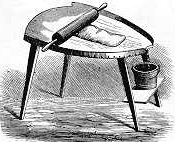
The simplest of the “modern” butter workers are generally only slightly more complicated than using a rolling pin on a wooden table. In the course of the 1800s more sophisticated combinations of roller and board were introduced. Rollers cranked by a handle, using metal fixings, lightened the work without being too complicated or expensive. People started to patent a variety of designs.

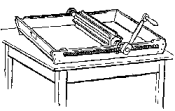
Butter worker with handle and roller
Butter worker from around 1880 with roller running on tracks and operated by turning handle.

In the picture the kitchen looks crowded with the butter worker and of course it is not a likely place for it to have been originally. You always need to do dairy work in a cool place even if you don’t have a dedicated dairy building. In a traditional kitchen the hot stove or hearth makes the room unsuitable for making butter or for doing any other work with milk or cream.

Butter making video

If you want to see the whole process, watch this video.

First you see the simplest way of making butter. A dairymaid skims cream off flat dishes of milk, churns, drains, rinses and works the butter before shaping a block with wooden “Scotch” hands aka butter pats. (She makes it look easy. Practice makes perfect.) Then the film shows mechanised churning with an end-over-end churn of a late 19th century or early 20th century type.

A butter worker from the 1840s, and one from the 1890s

butter worker 1890s with dairy school students
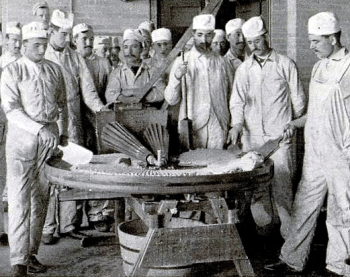
Students at the Wisconsin Dairy School with a butter worker, c1894.

Among the implements particularly worthy of notice, was a butter-worker, presented by Amherst Hawes, from the farm of Col. J. W. Lincoln, Worcester [Mass.]. It was a kind of brake. A marble slab placed on a table, with a slight declivity to let the buttermilk run off, formed the place for working the butter. A fluted roller, to which was attached a handle three or four feet long, fastened at the lower end to a swivel, constituted the power for working the butter, which was done by passing the roller backwards and forwards over it, applying as much pressure by means of the hand, as is required.
From: The Cultivator, A Monthly Journal to Agriculture, Horticulture, Floriculture and to Domestic and Rural Economy, Albany NY, 1844

Photos

Photographers credited in captions. Links to originals here: Woman with churn and Kitchen picture. Also see more picture info here.

//
http://pagead2.googlesyndication.com/pagead/show_ads.js

Pie birds: how old are these collectibles?

ceramic pie birds
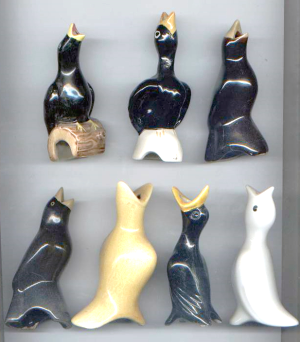
Blackbird pie funnels. Even the yellow one is a classic. Photo by Andy Roberts.

How many pies today are baked with a little ceramic chimney inside that supports the crust and channels away steam so that hot fillings don’t burst out in places where they shouldn’t? Also called a pie funnel, vent, or whistle, they don’t actually have to be birds, though using a little pottery bird with dark feathers and bright yellow beak is a nice reminder of the song about four and twenty blackbirds baked in a pie. You are as likely to see them in a collector’s cabinet as in a pie dish, but they can be useful. Pastry crust is less likely to end up drooping or soggy when a pie funnel is doing its bit to help.

All the same, they don’t really seem like cookery essentials, and this could help explain why they don’t seem to have been around for much more than a century. I’ve looked in vain for them in Victorian cookbooks and housekeeping manuals from both sides of the Atlantic. Mrs. Beeton’s comprehensive advice from the 1860s covers all sorts of pastry equipment but there’s no sign of a pie funnel. Pie funnels appeared around 1880 along with other not-quite-necessary late 19th century kitchen gadgets. Many similar “chimneys”, “crust supports” etc. were patented over the next couple of decades.

pie funnel nutbrown
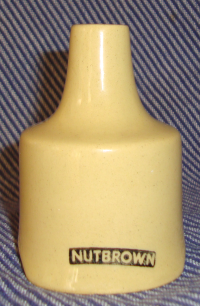
Pie funnels like this were well-known in mid-20th century British kitchens. Nutbrown was a brand name for a range of small kitchen items. Photo HomeThingsPast.

Classic blackbird funnels

Clarice Cliff added pie blackbirds to her range of ceramics in the mid-1930s. At least one expert says this was her own original idea, and it was the first British pie bird registered design, but in Australia there was a similar pie blackbird funnel designed by Grace Seccombe a few years earlier.
Nutbrown pie funnels

From the 1930s to the 1970s and later a plain white or yellowish pie funnel was a familiar item in UK homes. The Nutbrown brand did well and its name is stamped on many vintage pie funnels. I am doubtful of claims that there was ever a Nutbrown Pottery. Pastry utensils of all kinds came from a company called Thomas (Thos.) M. Nutbrown Ltd. of Blackpool, England whose range of kitchenware also included many stainless steel things like toast racks, cookie cutters, and can-openers. By the 1980s Nutbrown kitchenware had been absorbed into the Wilkinson Sword group via a company which made scourers and cutlery.

Pie funnels in the USA

pie vent late Victorian
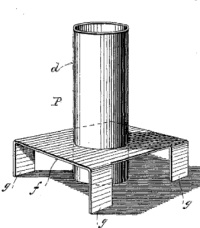
Pie ventilator - drawing for an 1891 US patent granted to Samuel Jenkins of Auburn, Maine.

In the early years of pie funnels they seem to have been more popular in the UK than in the US. There are few American patents in the quarter century after 1880. The first I found was a “pie-ventilator” from 1891 (see picture) and the next was an 1897 “pie-crust support” patent granted in the US to an Englishman. Meanwhile in England dozens of designs were registered, and pie-related businesses liked to distribute simple ceramic funnels with their branding on. The big surge forward with animal and character pie “birds” started in the 1940s, according to the The Oxford Companion to American Food and Drink.

Names

By the way, the only name for this kind of thing in the Oxford English Dictionary is pie funnel. Their first date for it is a 1910 entry in a department store catalogue. They don’t mention pie birds.

pie funnel…a funnel-shaped device placed within a pie while it cooks to support the piecrust and to provide a vent for steam.

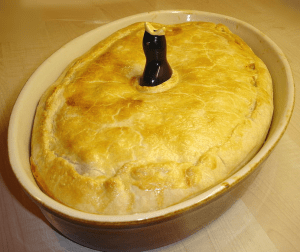
Bird with pastry on its chest and a beak full of steam. Photo by thecopse.
Photos

Photographers credited in captions. Links to originals and/or license here: Pie birdspie with bird. Also see more picture info here.