Muff warmers & other antique hand warmers

antique muff or hand warmer
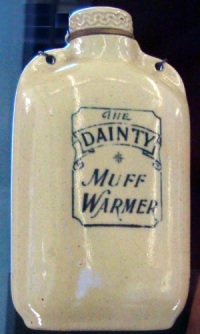
Small stoneware hot water bottle to fit inside a fur muff, c1910. Made by S. Maw, Son, & Sons in London. Photo by HomeThingsPast.

A hundred years ago a woman going out in the cold of winter could tuck a miniature hot water bottle inside her fur muff to keep her hands warm: like Maw’s Dainty Muff Warmer in the photo. This kind of hand warmer was on sale in late Victorian and Edwardian England.

The Thermos Hot-water Muff Warmer is a delightful little invention which is sure to be appreciated by my readers.
Ada Ballin, Womanhood, 1904

Poorer people had to find simpler ways of coping with a cold journey: heated stones or potatoes in a pocket, perhaps.

Ma slipped piping hot baked potatoes into their pockets to keep their fingers warm, Aunt Eliza’s flatirons were hot on the stove, ready to put at their feet in the sled. The blankets and the quilts and the buffalo robes were warmed, …
Laura Ingalls Wilder, Little House in the Big Woods (story of the early 1870s in Wisconsin)

The branded stoneware muff warmer was a new take on elegant ceramic or silver hand warmers that ladies’ maids filled when their mistress was about to set out on a cold carriage ride or walk. With carrying strings and tight stoppers, and optional fabric cover, these were clearly designed for people going out from home.

Hand warmers indoors

earthenware brazier or hand warmer
Dutchwoman covers her hands with her skirt to warm them over a terracotta pan of glowing coals c1650. Detail of painting by Caesar van Everdingen.

Hands could be cold indoors too. Plenty of people made good use of a hand warmer in a room or workshop with neither fireplace nor stove. Most parts of Europe had a variety of portable warmth providers, from silver braziers to ceramic novelties to heat-retaining bricks.

An earthenware pot with glowing charcoal was a common source of portable heat. It might be put on the floor, used as local heating or as a foot warmer, but it could also be raised up to warm someone’s hands -as in the picture. At night it could be used in a bed wagon.

Portable containers for hot water or glowing embers are sometimes called hand warmers even when they are used for more than just cold hands.

Pocket warmers

Neat little hinged cases with sticks of charcoal inside were in use in Europe by the first world war, when some officers carried pocket warmers. Someone patented a design in the US for a similar case holding heated metal slugs but I don’t know if these were ever made. There were also tubes to hold charcoal rods.
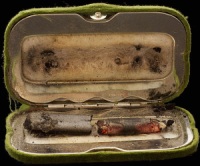
Pocket hand warmer. Probably early 20th century German. Photo by Matthias Kabel.

One of the newest inventions for winter comfort is a small hand warmer consisting of a hollow cylinder of fiber. A small pencil of heated charcoal is inserted through one end. The device will keep warm … for two hours.
Popular Science, USA, 1924

Chinese & Japanese handwarmers

You can’t really discuss antique handwarmers without mentioning the traditions of Eastern Asia.
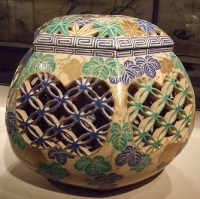
Japanese hand warmer
Ceramic te-aburi hand warmer, Japan, 19th century. Photo by Mary Harrsch.

Japanese homes might offer guests a small roundish ceramic pot with fuel in to warm their hands. Called a te-aburi , it could be used by an individual at the same time as a hibachi brazier big enough for a whole group of people.

Copper or bronze box-shape hand warmers a few inches across, often with carrying handles, were called shou lu in China: convenient, portable, with glowing coals inside. China and Japan had used both metal and ceramic hand warmers for many centuries. The perforations were an attractive part of the design as well as being functional.  I like this tiny piece of Chinese pottery for warming 7th century hands.
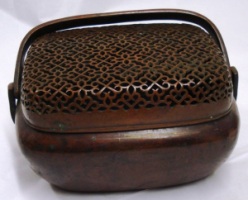
chinese hand warmer
16th or 17th century copper hand warmer, or shou lu, 13.5 cm (5 in) long. A classic Chinese design: box, perforated lid and handle. Photo by the British Museum

European travellers in the later 1800s and early 1900s were interested in the little heaters they saw in the Far East. Some people called them “Japanese muff warmers” and recommended them for nursing and medical purposes. One Englishman bought one for his own winter outings and praised the:

…little stoves which the Japanese women put in their sleeves and obi [wide sash]. They are small enough to push up the sleeve of a [European] coat, and…will keep alight for four or five hours.
Walter Tyndale, Japan and the Japanese, 1910
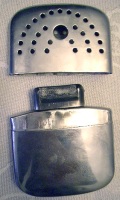
Hakkin hand warmer
Hakukin-kairo invented in 1923 by Niichi Matoba who founded the Hakkin company. Photo by Pete.

These could be lit with a simple paper fuse in 1910, but it was not long before a modern version of the metal “box” hand warmer was introduced to Japan. It was ignited with platinum catalyst technology. The Hakkin hand warmer or kairo, invented in 1923, looks like a cousin of the cigarette lighter, but I like to think it was inspired by its older ancestors.

S. Maw, Son, & Sons

This English company’s Dainty Muff Warmer was by no means an important product. Maw’s had been dealing in surgical and pharmaceutical supplies from 1807 onwards. One of their early earthenware products was an inhaler (from the 1860s or before). By the early 1900s they were making ceramic foot warmers as well as hand warmers, and also baby feeders, toothpaste pots and more. The company name varied over the years. From 1901-1920 they were S. Maw, Son, & Sons of Aldersgate Street, London.

Photos

Photographers credited in captions. Links to originals and/or licenses:
German pocket warmer, Chinese warmer, Japanese warmer, Hakkin warmer, or see more picture info here.
//
http://pagead2.googlesyndication.com/pagead/show_ads.js

Sock stretchers, stocking airers, and sock blockers

sock stretchers
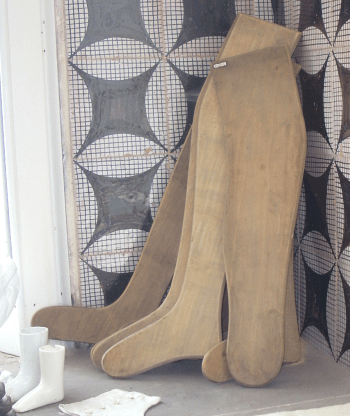
A few wooden stocking stretchers and a pair of unusual small ceramic sock stretchers too. Photo by HomeThingsPast.

In the late 1940s a Canadian housewife, Joan Colborne,† counted her sock stretchers before tackling a backlog of laundry. She “only” had four pairs and so could not wash more than eight woollen socks at a time. If socks were not stretched out while drying they might shrink.

Stretchers like the ones in the photo were the best way of keeping socks and stockings the right size and shape after laundering. If they had holes all over to help air circulate so much the better. The flat wooden legs, clad in long woolly socks, were hung from outdoor clotheslines or given a place to dry indoors.

Since long socks always used to be called stockings, or hose, these wooden leg shapes were originally called stocking stretchers or airers, but the name sock stretchers was more common by the mid-20th century.

They were used by manufacturers as well as at home: an industrial invention with benefits for people doing domestic chores. Hosiery producers sometimes called them stocking boards.

By the time of World War I stretchers seemed so important for sock care that the Red Cross and other people knitting socks for soldiers sometimes sent stocking stretchers along too.

At Caldwell, under the direction of Mr. Howard D. Thayer, a number of stocking stretchers have been made for the soldiers’ use.   (1918 New Jersey School Bulletin)

Wire stretchers

wire sock stretcher patent 19th century
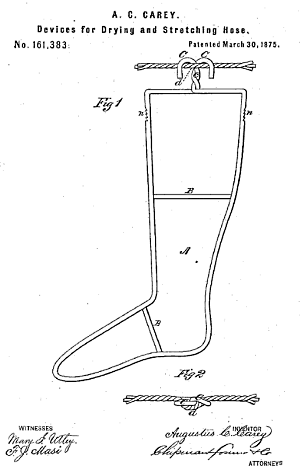
1875 patent for a wire stocking stretcher issued to Augustus C. Carey of Boston MA

Sometimes you see metal sock stretchers made of wire. As long as they were truly rust-free they were probably a better design: more air passing through, and no damp, warped wood. A patent in 1875 seems to be claiming inventor’s rights over the idea of using wire for stocking stretchers, while also patenting other new features in “devices for drying and stretching hose”. The patentee, Augustus C. Carey, was described as “the inventor of more than 100 valuable electrical and mechanical devices” in an obituary.

Although stocking stretchers were certainly used in Britain, especially in big households, it seems that they were most popular in North America. After World War II, when a few more sock stretchers were provided to the troops, there was news of socks that would not shrink. American ads stressed that you could now manage without the hassle of using sock stretchers.

Throw away those annoying sock-stretchers — just wash Sarfert Socks in the usual way. They’ll not only keep their knitted size after many washings, but they’ll wear longer and stay soft and pliant as when new.   (1947 ad)

DuPont nylon will keep their shape, looks, and smartness for a long, long time. Throw away your sock stretchers too because under normal washing conditions these new Bear Brand honeys won’t shrink, won’t stretch, they’ll always fit.   (1949 ad)

children's stockign stretcher ad
1907 ad for child-size stocking stretchers, to suit soft, luxurious baby socks. Only 25 cents a pair, says the ad in the Daily True American.

Some people still expected sock stretchers to stick around for a long time. In 1948 the Spokane Daily Chronicle published a sceptical column titled Put-up-or-shut-up Policy Issued Against Science?.

As for woolens that won’t shrink, I see that sock stretchers are still being sold…   (Henry McLemore)

Sock blockers

sock blockers
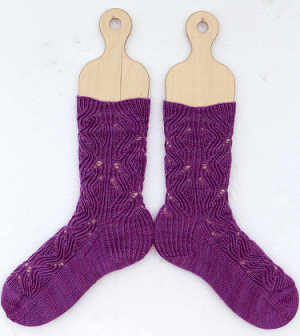
Sock blockers with hand-knitted socks. Photo by ulygan.

Well, that journalist was partly wrong, and partly right. Sock stretchers have come back. A few people use them for wet wool hiking socks, and they’re also popular with knitters, who call them sock blockers. A new generation of hand-knitters use sock blockers to shape up newly-knitted socks. Blocking means encouraging pieces of newly hand-knit fabric to take their intended shape: by dampening, pressing, pinning etc. Sock blockers is a 21st century name for the 2-dimensional wooden legs, although knitters have used “blocking” techniques for longer. I found a couple of mentions of sock blockers before the new millennium, but the name really only took off after the year 2000.

Notes

†See: Joan Colborne, Letters from the Manse, 2003

Photos

Photographers credited in captions. Links to originals and/or licenses: sock blockers by ulygan, or see more picture info here

//
http://pagead2.googlesyndication.com/pagead/show_ads.js

Wedgwood jasperware: solid jasper or jasper dip?

wedgwood jasper cupid psyche 18th century
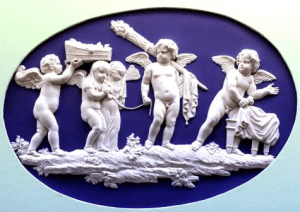
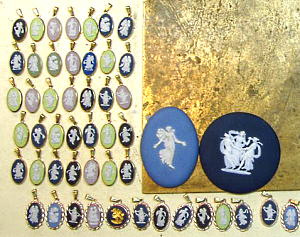
Wedgwood jasperware plaque with Cupid & Psyche marriage from Greek mythology, 1770s. Photo by ego technique.

Jasper dip and solid jasper are two different kinds of Wedgwood jasperware. Both have white classical designs on a coloured background, and look similar to non-experts. If in doubt you are always safe calling this style of pottery jasperware.

Solid jasper came first. After secret experiments in the early 1770s, blending clays with other ingredients, Wedgwood produced a range of hard stoneware with an unglazed, matt blue or slate-coloured finish, and white scenes, figures and motifs in a neo-classical style. Most of the designs were carefully sculpted copies of classical Roman or Greek ceramics – pottery in “antique form” as it was called then.

green jasperware teapot 1790
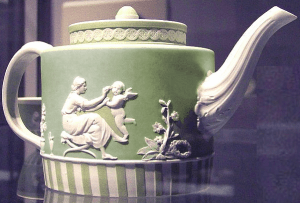
Jasper dip teapot c1790 with relief decoration using a design by Elizabeth Templetown. Photo by Maia C.

The colour was incorporated in the basic mix for solid jasper. This formula was expensive to manufacture and Wedgwood soon developed an alternative – the jasper dip, or surface jasper. This was a way of tinting only the visible surface, leaving backs and insides un-coloured. As well as light Wedgwood blue, colours used for jasper dip during this period included deep blue, lilac, olive, light green, black, pink, and yellow.

White ornamention was made in a mould, then attached to the coloured vases, tableware, portrait medallions etc. This so-called “sprigging” technique was already familiar to potters of the time.

The Cupid and Psyche marriage scene in the first photograph was produced in different sizes, from a small cameo ring to a substantial over-the-fireplace panel. Wedgwood wall plaques in this style fit well into Georgian interiors with white plasterwork ornamenting coloured walls and ceilings.

wedgwood jasperware jewelry brooches
Jasperware cameos - brooches and other small decorative pieces - being made on a 21st century workbench at the Wedgwood pottery in Stoke-on-Trent. Photo by Sunil.

Jasperware was probably Josiah Wedgwood’s most successful creation, imitated by Sèvres and Meissen, and despite going out of fashion for part of the 19th century is still made and appreciated  today. When people say ‘Wedgwood’ or ‘Wedgwood china’ they may well be thinking of this particular kind of pottery with its distinctive white scenes on unglazed colour.

…a fine-grained white stoneware for the ‘sprigs’or bas-reliefs…applied to small background tablets which he coloured blue with a cobalt stain. This blue Jasper has become Wedgwood’s most famous product…
…some had just a ‘blue dip’ because the cost of the cobalt was so high; another, solid Jasper, had the blue colour throughout…
Robert Copeland, Wedgwood Ware

Photos

Photographers credited in captions. Links to originals here:
Cupid and Psyche plaque, teapot, workbench with small jasperware.
More picture info here

//
http://pagead2.googlesyndication.com/pagead/show_ads.js

Love tokens and betrothal gifts carved from wood

carved wooden love spoon
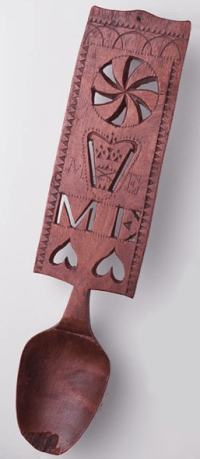
Lovespoon from Wales carved with hearts and initials. Photo from Museum of Wales

I keep coming across nicely carved antiques that were made to be useful, while the decoration shows they were designed as courtship, engagement or marriage gifts. The idea of handmade love tokens is still alive today: especially the tradition of carving love spoons. Craftspeople who make them often use longstanding folk art designs that evolved over time.

Love and commitment gifts developed in pre-industrial communities when craft skills were widespread. Men could work with wood. Women understood textiles and thread. Girls often prepared for marriage by sewing for their beloved, as well as weaving and stitching linens for their future home. Young men made something wooden that would be of value in a woman’s adult life: for instance, a knitting sheath, mangle board, or distaff.

Originally I wanted to make a list of as many different European and North American betrothal or love gift traditions as possible, but even if you limit it to Europe and European immigrant communities in the USA, and limit it to home-made carved wood, or treen, the task is still huge. Still, I’ve made a start below and would enjoy hearing more in the comments.

Lithuanian spinning board and needle
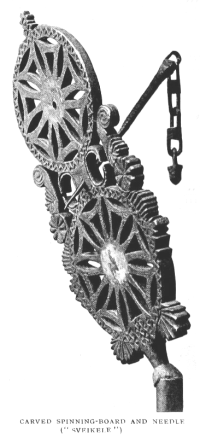
Elaborately carved board with pin is a kind of distaff holding unspun fibre: a characteristic Lithuanian spinning wheel attachment called prieverpste.

Spoons

Spoons have to come first: not only Welsh lovespoons like the one in the picture, but Scottish ladles and pairs of spoons linked by a carved chain, and many other regional types. Chained pairs of spoons are still known as a marriage “ritual” object in Germany. Scoops and spoons sometimes incorporated a freely-moving “caged ball” in the design. Another way of showing off the carver’s skill was to carve all the links from one piece of wood. The single piece of wood may symbolise the marriage union.

Textile tools

Knitting, spinning, and needlework aids which were carved and decorated by loving young men include knitting sheaths, famous in the Yorkshire Dales, lace bobbins, distaffs, and spinning wheel parts like the Lithuanian distaff board in the picture. Pincushions inside a carved box were made by some lovers.

Laundry tools

The Baltic countries, Russia, and parts of eastern Europe have very strong traditions of fine wood carving on the humblest domestic items. This allowed for a wide range of pre-marriage gifts even including decorative washing bats, not very well suited to modern ideas of romance since they’re only ever used for arduous, repetitive routine work. A slightly more glamorous laundry item was the classic Scandinavian engagement gift: a mangle board.

Culinary equipment

gingerbread mold
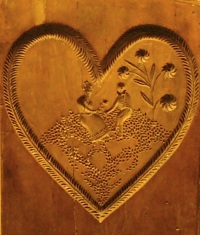
Gingerbread mould from Silesia, Poland. Photo by praccus.

Gingerbread or cookie moulds give lots of scope for personalised carving which will look good twice over: once as an ornament on a shelf and also on home baking at future meals and social gatherings. German springerle moulds are an example. Some butter stamps were carved as love gifts. Other food-related opportunities for betrothal gifts with initials and hearts and anything else you want include rolling pins, salt boxes, and bread boards.

Dress & grooming

Stay busks and combs were once well-liked betrothal or love gifts. Stay busks, worn close to the heart, were for shaping a corset. But they weren’t always wood. Whalebone or scrimshaw busks were carved by British sailors. Some of the most elaborate folk art carving styles in maritime regions developed on long sea voyages, it is often suggested.

The finest gifts

In some regions professional wood-carvers offered a service to young men who wanted to impress their sweetheart or her family. Is this a disappointment?  If I had a wonderful heirloom with my ancestors’ initials on, I would like to think it was home-made, not purchased.

Some gifts chosen by wealthy lovers are obviously not made by amateurs. Spoons and lace bobbins, for example, can be so finely-crafted and elaborate that they stand out from homemade folk art and are clearly the work of expert craftsmen. Other love tokens often commissioned by the privileged classes included combs (in the Renaissance especially) and snuff boxes given to men by women.

Photos

Photographers credited in captions. Links to originals here: Welsh love spoon, gingerbread mould, or see more picture info here.

//
http://pagead2.googlesyndication.com/pagead/show_ads.js

Showers – 19th century luxury and health

antique shower 1890s
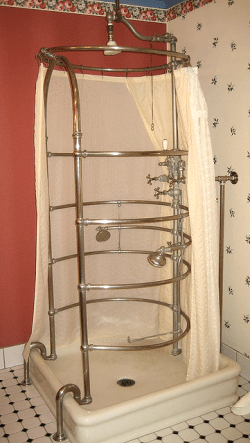
American shower, probably 1890s. Water from above and from the sides, various different settings. Photo by Dan Theurer

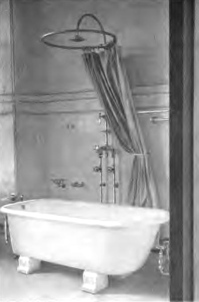
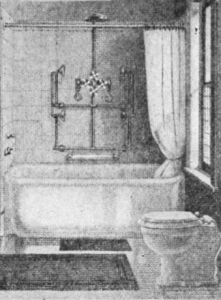
The earliest showers were rather like having a pail of water tipped over you from a height. By the 1880s there were some more sophisticated contraptions available. They could be fully integrated with indoor plumbing, and came complete with an array of taps and valves to adjust temperature, water flow, and more. Patent mixers were invented to make sure the water could never be scalding hot. One manufacturer promised their needle shower would not let water go over 98 degrees F (body temperature). Showers were supposed to be invigorating and health-giving, so cool or lukewarm water was considered beneficial.

  • A needle bath or needle shower directed jets of water all round the torso. Sometimes the water flow could be adjusted, and a particular setting was promoted as a liver shower or bath, supposedly offering a stimulating massage for internal organs. Its energising effects were considered more suitable for men than women. Needle showers were marketed to gentlemen’s athletic clubs as well as private houses. Some people call them cage showers.
  • A rain bath or shower was an overhead spray coming from a circular head pointing straight down or slightly slanted. Also called a spray bath, it was a desirable fitting for modern, hygienic public baths and hospitals.
  • Combination showers with a variety of features were promoted by leading manufacturers. Some were decorative as well as cleverly designed. They led to the canopy shower.
vintage canopy shower bath
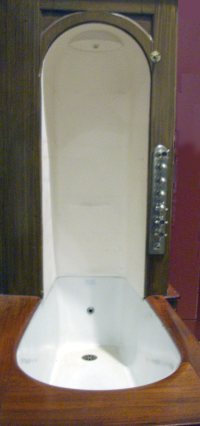
Canopy bath, made in the UK early 1900s. Photo by HomeThingsPast.
  • Canopy showers or canopy baths built several bathing features into a fine piece of furniture. Designed for bathrooms in well-decorated homes, these were available for the well-heeled buyer in North America and Europe in the late 1800s and early 1900s. The porcelain enamel tub extended upward at one end into a tall curved shower wall, usually with a hood. This impressive bathroom centrepiece could be seven feet high. Many were fitted inside dark polished wood cases; some had ornamental enamelled metal exteriors. Douche and plunge settings were sometimes included. The plunge was a gushing flow of water, not a spray or fine jets. Other features of needle or canopy baths could include a kidney, spinal, or bidet spray, or a special shampoo spray.
English needle shower bath
"Improved needle bath" by Smeaton of London, 1890, had 6 rows of needles, each with its own controls. Shower, douche, and sitz were "usually fitted". Patent mixer and thermometer were extra. Upmarket Victorian hotels and aristocratic customers using Smeaton baths and showers are listed in the ad.

UK manufacturers tried to entice wealthy late Victorian customers with a steady supply of new features. As well as all the shower options, you could have fine carving on the canopy bath surround, a curving bath with extra space at the shower end, or an open top “Oriental” bath which avoided any “sense of confinement”. Instead of being enclosed in dark wood, the Oriental model was metal decorated with stencilled friezes, fluted columns, and cornices. Copper and other metal canopies came into vogue, and started to replace the heavy mahogany look.

When did ordinary homes get showers?

Around 1900 these were splendid luxuries for rich people, who often bought them for the supposed health benefits of special kinds of bathing. A lot of routine hygiene depended on washstands and hip baths in the bedroom. But when were showers fitted in middle-class homes?  There are plenty of statistics about the percentage of homes in various countries with either a bath or a shower, but very little about showers alone.

The 1920s was when showers began to spread to “normal” homes in the USA, especially new homes, according to many writers.† The pictures at the bottom of the page give a foretaste of this, with US bathroom designers illustrating not-too-lavish bathrooms with showers included. Sears Roebuck was selling showers by 1915. By 1965 a study of one thousand American middle-class homes found that 85% had both a tub and a shower.*

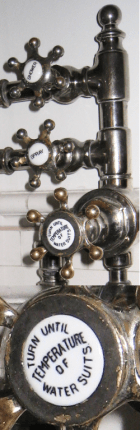
"Turn until temperature of water suits." Faucets on needle shower in Seattle, c1914, with enlargement of one. Photo by Michael Cornelius.

Even though British shower manufacturers and wealthy customers had kept pace with American developments up to WWI, it stopped there. Bathrooms were different on different sides of the Atlantic. Showers appeared in sports clubs and other communal facilities but remained uncommon in private homes in Britain before the 1970s/80s. (Sorry, only anecdotal evidence so far, but I’m pretty sure.)

Many European countries were far slower than the USA to adopt showering at home. Possible reasons include older housing stock without space for showers, and progressive attitudes to new technology in America. Attitudes to hygiene varied from culture to culture.  Sweden was one of the first European countries to take home showers to its heart. 1980s studies in Sweden and Minnesota showed that in both places most homes had a shower and a bathtub.‡

Photos

Photographers credited in captions. Links to originals here:
American needle shower, shower controls.
More picture info here

Notes

†For example, Old House Magazine, Nov 1994
*Marilyn Langford, Personal hygiene attitudes and practices in 1000 middleclass households, Cornell University, 1965
‡Rita J. Erickson, Paper or plastic?: energy, environment, and consumerism in Sweden and America, 1997
Also see:
Katherine Ashenburg, The Dirt on Clean: An Unsanitized History
David Eveleigh, Bogs, Baths, and Basins: The Story of Domestic Sanitation

Porcelain and enamel are two different names for the same glazed coating on iron baths: usually white but not always.

shower 1880s
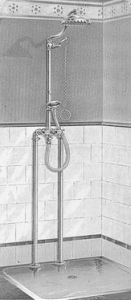
1888 - nickel-plated brass shower with shampoo pipe, for athletic club rooms, or for fitting over a bath. Curtain ring available as an extra. Ad for Mott of New York.
shower bath 1910
Shower c1910 over bath. Porcelain enamel on iron tub. Curtain could be thick cotton or silk lined with rubber. USA.
needle shower tub 1916
c1916 - Mott's combined "needle and rain shower" has foldaway needle "arms" that the user can swing forward when required.

//
http://pagead2.googlesyndication.com/pagead/show_ads.js

Boot scrapers

painted boot scraper
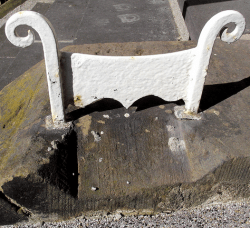
Simple scraper at Münster prison, Germany. Photo by Dave.

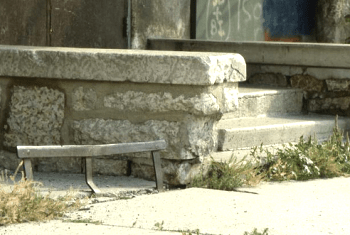
Who uses boot scrapers in the 21st century? Portable ones are on sale for gardeners, and for anyone else who wants to tackle muddy boots before approaching clean houses, cars, or paths. But the days of iron scrapers being placed at every door are over. The finest ornamental 19th century scrapers are still there beside elegant townhouses and country mansions. Scrapers have stayed on some smaller homes, especially where the scraper is embedded in the wall. Plain, functional scrapers sometimes remain by historic buildings.

Gone are the days of architects and builders planning for boot scrapers:

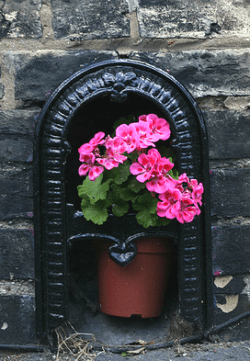
English boot scraper arch shape
Arch framing scraper set into wall - a design once used widely in England. This one is in Cambridge. Photo by Nick James.

Scrapers for the feet may be let into the wall of the cottage, on each side of the door, a cavity being left over the scraper for the foot, and one under it for the dirt. There are various forms of scrapers for building into walls, which may be had of every ironmonger; and all that the cottager has to do is to choose one analogous to the style of his house. There are detached scrapers in endless variety; the most complete are those which have brushes fixed on edge, on each side of the scraper…
An encyclopædia of cottage, farm, and villa architecture and furniture …John Claudius Loudon, London, 1839

Schools no longer put scrapers on their list of essentials:

The Scraper ….. the steps or platform leading to the door ….. either will be incomplete without a strong, convenient shoe scraper at each side. Two will be required, for the reason that the pupils enter the school, morning and afternoon, about the same time, and if there be only one scraper, it will either cause delay or compel some to enter the building with soiled shoes. Cleanliness and neatness are amongst the cardinal virtues of the school-room ; and every means of inculcating and promoting them should receive the earliest and most constant attention.
JG Hodgins, The school house: its architecture, external and internal arrangements, Toronto, 1876

Canadian boot scraper
Old school in Winnipeg, Canada, with a long boot scraper for several children to use at once. Long scrapers were a typical school design. Photo by Per.

What we do have now are enthusiasts who just love old boot scrapers. Since these are often fixed into stone, they are best collected by photographers. One collection is mostly from the UK or US. Another is from Brussels where, says the introduction, scrapers used to be part of the etiquette and ritual for entering both public buildings and individual homes. A Toulouse “collector” has analysed local styles and named them: ram’s horns, fir-cones etc.

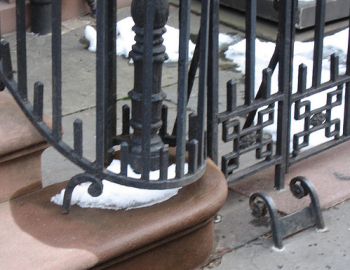
boot scraper railings
Scraper discreetly set at foot of steps with iron railings in New York. Photo by Kim Navarre.

When did boot scrapers arrive as a normal part of daily life? The first print references start mid-18th century, when they are simply called scrapers.* I haven’t seen any that go back as far as this, but am hoping a “collector” may know of one and add a comment – please. Foot scraper and shoe scraper are terms also used, but boot scraper is far the most common name.

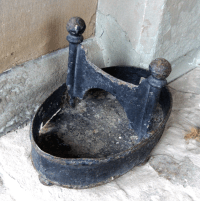
portable boot scraper
Movable cast iron scraper with tray to catch dirt. Probably late Victorian. Photo by HomeThingsPast.

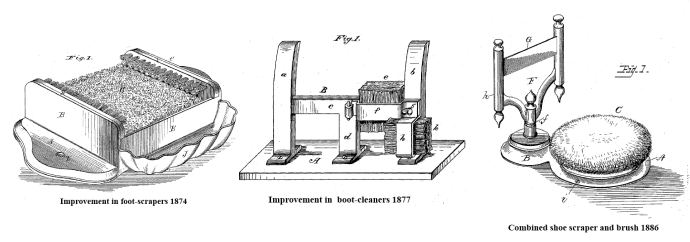
They attracted 19th century inventors with an eye on patenting newer, cleverer kinds of scraper: quite often combined with brushes. Some of these look useful, some don’t, but none has the elegance of the best architect-endorsed scrapers, chosen to suit the house they were protecting from mud. One design that stands out from the crowd is seen in New York  and Savannah, Georgia. By integrating the scraper into the railings it avoids the “afterthought” look of a shoe-cleaner that doesn’t suit the architectural style of the house, but it isn’t quite as obvious as a free-standing scraper. Did visitors know where they were supposed to clean their footwear?

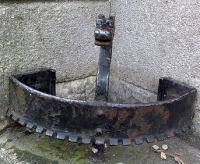
 cast iron scraper in corner
Scraper with dragon head in Oxford on 1882 building. Photo by Barnaby S.

Specification of Works to be done in erecting and completely finishing a Villa….with all the necessary appurtenances [sic]….
Iron-founder…Provide cast-iron strong tray boot scrapers to front and back doorways.
Specification of Works required to be done in erecting and completely finishing a Pair Of Semi-detached Cottages….
Iron-founder….Fit up to each front door a neat iron knocker and a neat iron-pan scraper.
Practical specifications of works executed in architecture, civil and mechanical engineering, London, 1865

boot scrapers 19th century
US boot scraper and brush combinations patented in 1870s and 1880s. Called foot-scraper, boot-cleaner, and shoe scraper, and all portable.
Photos

Photographers credited in captions. Links to originals here:
White boot scraper, school boot scraper, arch scraper, scraper and railings, dragon scraper.
More picture info here

Notes

*Oxford English Dictionary cites Swift’s Directions to Servants 1745

//
http://pagead2.googlesyndication.com/pagead/show_ads.js

Medieval and Renaissance combs

H-comb France 1500
French boxwood comb made c1500. Letters say "por vog servir", "to help you". ("Pour vous servir" in modern French) Photo by Thomas Cowart.

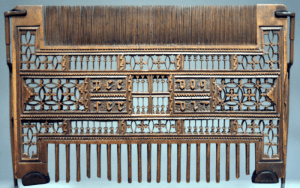
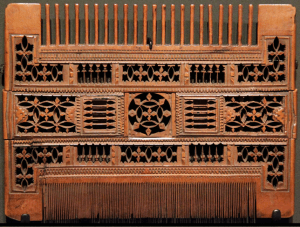
The most beautiful combs owned by ladies in late medieval and Renaissance times were highly ornamented in between their two rows of teeth. They look special, and they are. Some of the best were given as love tokens, and the fine, lacy carving included mottos, hearts, dates or initials. Did the young ladies use their admirers’ gifts? Or did the real hairdressing get done with plainer combs? The simple comb in the 17th century painting below looks easier to hold than a really gorgeous piece of carved wood.

H comb for combing hair 1600s
Combing a young lady's hair in 1633. From a Jan Miense Molenaer painting with various titles: Woman at her Toilet, Vanity, or Lady World.

And would you use your romantic, artistic comb for everyday hair hygiene? Apologies to anyone who is squeamish about infestation, but the fine-toothed side of the comb helped people deal with nits and lice, which people used to take more for granted than today.

H-combs

The H-shaped structure framing the teeth means that some people call these H-combs. Archaeologists call them double-sided. In Northern Europe there were double-sided H-combs in the early medieval period, while in the Middle East they go back more than 2000 years.

In late medieval Europe, especially France and Italy, beautifully decorated combs were considered a desirable gift from a knight to his lady. They could be teamed with a matching mirror and hair parter, and fitted into a dressing case (trousse de toilette), typically made of leather. Boxwood, bone and ivory were the most common materials; in all of these the teeth needed to be cut along the grain for strength. Boxwood is probably the only European wood dense enough to allow a special saw (a stadda) to cut fine teeth into the comb. These saws had two blades set close together and could cut 32 teeth to the inch or even more.† There are numerous pictures from medieval times onward showing ladies using plain H-combs, like the one from the Luttrell Psalter below right. Yet I don’t know of any showing an elaborately carved and pierced comb being used.

Medieval lady hold H comb as maid helps with her hair
A lady and her comb, with a maid helping arrange her hair. Early 14th century.

The most decorative combs started to become less popular as love gifts around 1600, though opinions vary on exactly when the fashion faded away. Plainer wooden H-combs were handmade up to 1900 or so. In the later 17th century there was a fashion for engraved tortoiseshell combs of this shape in the West Indies. Incised patterns with white filler, and frequent use of tulip designs, suggest combs there were influenced by Dutch craftsmanship.

†Information about the saw and other historical details come from Edward Pinto’s Treen and other wooden bygones. He casts doubt on the idea that many surviving combs were “liturgical combs” for priests to use when preparing for church rituals. Some of these were undoubtedly secular combs, made for rich people, but not for the clergy, he believes.
A lover may freely accept from her beloved these things: a handkerchief, a hair band, a circlet of gold or silver, a brooch for the breast, a mirror, a belt, a purse, a lace for clothes, a comb [pecten], sleeves, gloves, a ring, a box, a keepsake of the lover, and, to speak more generally, a lady can accept from her love whatever small gift may be useful in the care of her person, or may look charming, or may remind her of her lover, providing, however, that in accepting the gift it is clear that she is acting quite without avarice. Capellanus, De Amore, Book 2, c1180

Pivoting carved comb from 16th century France
Comb with two flat sections that pivot into a cross shape, from 16th century France. Photo by Kotomi Yamamura
boxwood comb 16th century French
French boxwood comb, 16th century. Photo by Kotomi Yamamura
Photos

Photographers credited in captions. Links to originals here: First comb, Other combs, More picture info here

//
http://pagead2.googlesyndication.com/pagead/show_ads.js

The White Frost Refrigerator: unique 100-year-old icebox

white frost refrigerator icebox
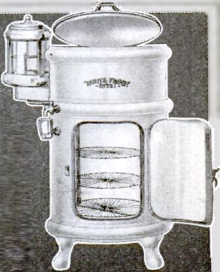
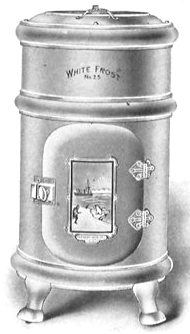
A White Frost Refrigerator from 1906. It had 2 revolving shelves and an internal water cooler.

Most iceboxes looked like plain wooden cabinets in the early 1900s. Without electric refrigeration, they were fitted inside with a space for  ice, which had to be topped up regularly to keep food cool and fresh.

Keeping the butter hard, the milk and cream sweet, and the meat from spoiling, is a part of the housewife’s trouble in the summer time.
White Frost ad from Carter’s Hardware, Sonora CA, 1913

The White Frost Refrigerator was the only cylinder-shaped icebox. A block of ice sat in a compartment under the lid and chilled air was vented into the food storage space below.  The makers said their distinctive model was:

  • More hygienic – easy-clean curved enamelled steel, food always in perfect condition
  • More scientific – better design, better insulated, economical with ice, revolving shelves
  • Desirable yet affordable – stylish, special, above-average price payable in installments

Advertising

white frost refrigerator crystal water cooler
The "Crystal" water cooler looked good on the side of White Frost Refrigerators in the 1920s. It left room inside for 3 shelves.

Excerpts from their ads show what White Frost Refrigerator Co. and their dealers thought buyers wanted. (To read about the manufacturer, designer, patent etc. please scroll down the page.)

…rolled steel, galvanized and beautifully enameled…nothing to swell, warp or shrink…no corners to dig out, no shelter for germs…absolutely wholesome…circulation of air so scientifically directed…there can be no moisture from the ice in the food chamber
Weis & Fisher ad, Rochester NY, 1905

…only sanitary refrigerator on the market, not a splinter of wood, no waste of ice, clean and odorless
Cahn’s ad, Youngstown OH, 1908

…sparkling, cleanly white…harmonizes so well with the modern white kitchens
Trice-O’Neal Furniture Store ad, Florida, 1925

In 1914 this ad targeted the man of the house. An icebox with US government approval, and a loving wife into the bargain. (Red lines added.)

Of course the advertisers wanted to appeal to women, but they also needed to persuade men. An ad in Popular Mechanics showed “Bob” and his wife in icebox-inspired closeness.

Features

  • 47in high
  • 27in diameter
  • Holding up to 110lb. ice
  • Double walls insulated with asbestos or aerofelt,  and maltha (asphalt) with “dead air space”, later models with granulated cork
  • 3 coats of white enamel inside
  • Exterior white with nickel or brass trim, or golden oak finish
  • Easy to move, on wheels
  • White Frost Sanitary Refrigerator an alternative name
  • “Crystal” water cooler attachment allowing for an extra shelf – from 1919

Manufacturers  and inventor

The first White Frosts were made in Jackson, Michigan even before a full patent was granted in 1906. The president of the company making them was Hugh L. Smith, a hardware entrepreneur and director of at least 2 other businesses. He also bought the Boeck Stove Company.

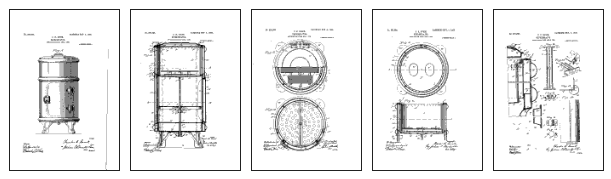
Charles H. Boeck patented various stove designs and other inventions too. His 1906 refrigerator patent describes him as assignor to the Jackson Metal Stamping Co. In the next few years he patented some improvements to the icebox. His 1919 patent for the water cooler attachment used a different company name: White Frost Refrigerator Co. White Frosts were sold through dealers in many different states, and were also available by mail order from Mechanic Street in Jackson. The price in its first few years was about $30, with a $20 end-of-summer bargain in Paterson NJ. By 1924 a store in Painesville OH was selling one at $74, reduced from over $90.

white frost refrigerator patent drawings
Boeck submitted 5 pages of drawings for the original 1906 patent.

//
http://pagead2.googlesyndication.com/pagead/show_ads.js

Marrow scoops, spoons & table manners

marrow spoons or scoops from 1700s and 1800s
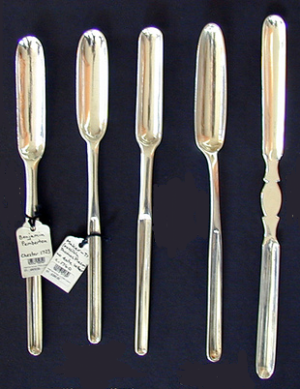
Silver marrow scoops from 1720s to 1850s (left to right). Photo by miladus

A silver marrow scoop is an elegant solution to a problem most of us don’t have today. How can you get the tasty marrow out of meat bones without abandoning your table manners?

Upper class diners adopted new rules of etiquette during the 1600s. Forks appeared on posh tables to help people eat with a less hands-on approach to cooked food. But forks didn’t help take the savoury jelly out of the marrowbones. You can get an idea of how this was done once upon a time by reading a mid-17th century etiquette book. The author thought it best for people to stop handling and “mouthing” bones altogether, but he would allow you to use one hand for meat bones as long as there was no gnawing, sucking, slurping etc. And definitely no banging, cracking, or biting. Get the marrow out neatly and decently – with a knife.

Suck no bones…Take them not with two hands…Gnaw them not…Knock no bones upon thy bread, or trencher, to get out the marrow of them, but get out the marrow with a knife…To speake better…it is not fit to handle bones, and much lesse to mouth them.
Make not use of a knife to breake bones…also breake them not with thy teeth, or other thing, but let them alone.
(Youths [sic] behaviour, trans. from French by Francis Hawkins, 1646)

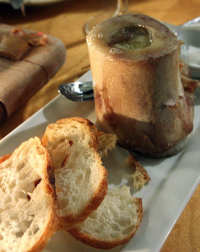
marrowbone served with toast or bread
Cooked marrowbone served with bread. Photo by Sifu Renka

Before the end of the century marrow spoons had arrived, starting in the 1680s. These new implements for eating marrow had a rounded spoon at one end with a narrow scoop at the other. In 1710 one was described as “a marrow spoon with a scoop at the other end”.* Soon the spoon evolved into an elongated scoop, usually with a narrower version at the other end. Many more were made during the 18th century: an era when an impressive variety of new culinary paraphernalia was developed for the prosperous classes – from gravy warmers to caddy spoons.

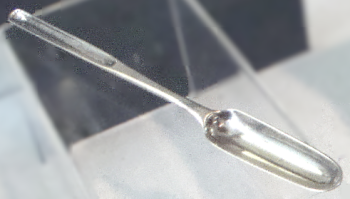
I wish I could find a written description of someone taking marrow jelly out of a bone in the early days of the new scoops.  Did no-one write about it at all? Later there are recipes for dainty dishes of prepared marrowbone that could be eaten quite easily; by this time the bones were being cut and served in a special way. Diners could still enjoy the traditional delicacy, but without handling the bones at all, not even excavating with a knife as a polite alternative to sucking. Probably the late 19th century marrow scoop in the last picture on this page was intended for this kind of dish. It doesn’t look suitable for fiddly excavation of bones cut from a big joint of meat, or from a whole animal roast on a spit.

marrowbones served Victorian style
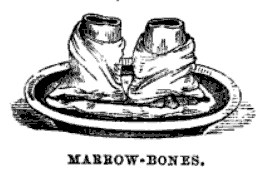
Marrowbones from Mrs. Beeton's recipe

Ingredients.—Bones, a small piece of common paste [pastry], a floured cloth. Mode.— Have the bones neatly sawed into convenient sizes, and cover the ends with a small piece of common crust, made with flour and water. Over this tie a floured cloth, and place them upright in a saucepan of boiling water, taking care there is sufficient to cover the bones. Boil the bones for 2 hours, remove the cloth and paste, and serve them upright on a napkin with dry toast. Many persons clear the marrow from the bones after they are cooked, spread it over a slice of toast, and add a seasoning of pepper; when served in this manner, it must be very expeditiously sent to table, as it so soon gets cold. Marrow-bones may be baked after preparing them as in the preceding recipe; they should be laid in a deep dish, and baked for 2 hours.
(Isabella Beeton’s recipe from 1861)

marrow scoop by spoon maker George Smith
Marrow scoop by George Smith - London 1780-1781. Photo by HomeThingsPast

The marrow scoop by George Smith III (picture left) comes from an important company of English spoon makers and silversmiths started by Thomas Chawner. They were active in London from the mid-18th to early 19th centuries.

marrow scoop late 19th C
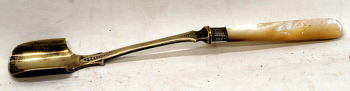
Late Victorian marrow scoop - silver plate, mother of pearl handle. Photo by Leeds Museums and Galleries
Photos

Photographers credited in captions. Links to originals here: 5 marrow spoons – n.b. dates and details on original photo, cooked marrowbone, Gge Smith scoop by HomeThingsPast, Victorian marrow scoop. More picture info here

Notes

* From The Lucubrations of Isaac Bickerstaffe in Joseph Steele’s Tatler: “a marrow spoon with a scoop at the other end”.

See also: a pewter marrow scoop

//
http://pagead2.googlesyndication.com/pagead/show_ads.js

Metamorphic library steps, chairs and tables

convertible steps table
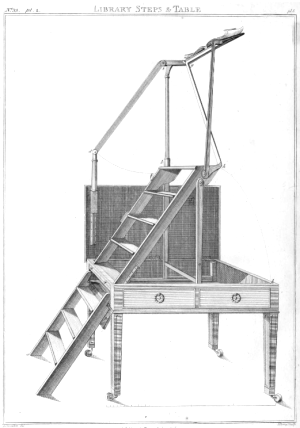
Sheraton first published this design for Library Steps & Table in 1793.

In the 18th century wealthy men with private libraries in their grand houses wanted elegant furniture around them. The upmarket cabinet-makers of the period created fine desks and chairs, but how could they design new, improved versions of the step-ladders needed for reaching books from the highest shelves?

One idea was to conceal steps under the seat of a long stool. Turned upright, its upholstered seat to the wall, it made a short ladder with three treads, each smaller than than the last: perhaps not a very stable arrangement. It is rare to find any of these on the antiques market, and it is unlikely that many were made, as better furniture soon followed.

Chippendale designed the kind described above in the 1750s, but in the next decade he created hinged steps that could be folded into a stool. This type can be seen at Harewood House and Nostell Priory in England. One was described at the time as a “large mahogany library stool with the seat to rise as a step ladder the seat stuff’d and cover’d with black leather”. (Nostell Priory accounts 1767) The other was given a neo-classical look with rosewood veneer and marquetry.

Benjamin Franklin had something better than a stool: a leather-upholstered chair with steps beneath. There are claims that his seat was the first ever chair and steps combination. Whether or not this is true, it is comfortable enough to be a real reader’s chair: ideal for someone who loves books as well as good furniture.

Tables were part of this new wave of convertible library furniture, and a British patent for a dual-function table with steps was registered in 1774. Sheraton published a design for one of these library tables before the end of the century. (Picture above)

This design was taken from steps that have been made by Mr. Campbell, Upholsterer to the Prince of Wales. They were first made for the King, and highly approved of by him, as every way answering the intended purpose. There are other kinds of library steps which I have seen, made by other persons, but, in my opinion, these must have the decided preference, both as to simplicity and firmness when they are set up. The steps may be put up in half a minute, and the whole may be taken down and enclosed within the table frame in about the same time.
Thomas Sheraton, The cabinet-maker and upholsterer’s drawing-book, London, 1802 edition

metamorphic library chair steps
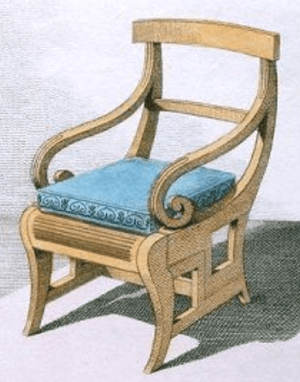
Steps folded under the seat of this Morgan & Sanders chair, designed c1811

The name metamorphic (shape-changing) was not used for the earliest pieces of library furniture, but appeared in a London patent of 1811. The first ever “patent metamorphic library chair” with curving arms spawned many varied chair designs, some quite plain, others very elaborate. Georgian or Regency pieces of dual-purpose library furniture can fetch thousands of dollars at antiques auctions, and even later Victorian metamorphic chairs may be quite valuable.

One 19th century curiosity is based on a library staircase design that was boxed in at the sides. One stair-tread was a hinged lid giving access to storage beneath. This was adopted as bedroom furniture and used in some homes as a commode to conceal the chamber pot for night-time use.

Note

Since I first wrote this short piece for another website, Clive Taylor has published a fascinating, detailed, and original dissertation on The Regency Period Metamorphic Library Chair.

//
http://pagead2.googlesyndication.com/pagead/show_ads.js