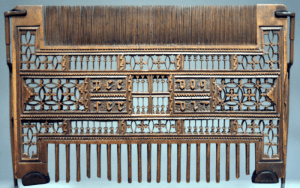
Medieval and Renaissance combs

H-comb France 1500
French boxwood comb made c1500. Letters say "por vog servir", "to help you". ("Pour vous servir" in modern French) Photo by Thomas Cowart.

The most beautiful combs owned by ladies in late medieval and Renaissance times were highly ornamented in between their two rows of teeth. They look special, and they are. Some of the best were given as love tokens, and the fine, lacy carving included mottos, hearts, dates or initials. Did the young ladies use their admirers’ gifts? Or did the real hairdressing get done with plainer combs? The simple comb in the 17th century painting below looks easier to hold than a really gorgeous piece of carved wood.

H comb for combing hair 1600s
Combing a young lady's hair in 1633. From a Jan Miense Molenaer painting with various titles: Woman at her Toilet, Vanity, or Lady World.

And would you use your romantic, artistic comb for everyday hair hygiene? Apologies to anyone who is squeamish about infestation, but the fine-toothed side of the comb helped people deal with nits and lice, which people used to take more for granted than today.

H-combs

The H-shaped structure framing the teeth means that some people call these H-combs. Archaeologists call them double-sided. In Northern Europe there were double-sided H-combs in the early medieval period, while in the Middle East they go back more than 2000 years.

In late medieval Europe, especially France and Italy, beautifully decorated combs were considered a desirable gift from a knight to his lady. They could be teamed with a matching mirror and hair parter, and fitted into a dressing case (trousse de toilette), typically made of leather. Boxwood, bone and ivory were the most common materials; in all of these the teeth needed to be cut along the grain for strength. Boxwood is probably the only European wood dense enough to allow a special saw (a stadda) to cut fine teeth into the comb. These saws had two blades set close together and could cut 32 teeth to the inch or even more.† There are numerous pictures from medieval times onward showing ladies using plain H-combs, like the one from the Luttrell Psalter below right. Yet I don’t know of any showing an elaborately carved and pierced comb being used.

Medieval lady hold H comb as maid helps with her hair
A lady and her comb, with a maid helping arrange her hair. Early 14th century.

The most decorative combs started to become less popular as love gifts around 1600, though opinions vary on exactly when the fashion faded away. Plainer wooden H-combs were handmade up to 1900 or so. In the later 17th century there was a fashion for engraved tortoiseshell combs of this shape in the West Indies. Incised patterns with white filler, and frequent use of tulip designs, suggest combs there were influenced by Dutch craftsmanship.

†Information about the saw and other historical details come from Edward Pinto’s Treen and other wooden bygones. He casts doubt on the idea that many surviving combs were “liturgical combs” for priests to use when preparing for church rituals. Some of these were undoubtedly secular combs, made for rich people, but not for the clergy, he believes.

A lover may freely accept from her beloved these things: a handkerchief, a hair band, a circlet of gold or silver, a brooch for the breast, a mirror, a belt, a purse, a lace for clothes, a comb [pecten], sleeves, gloves, a ring, a box, a keepsake of the lover, and, to speak more generally, a lady can accept from her love whatever small gift may be useful in the care of her person, or may look charming, or may remind her of her lover, providing, however, that in accepting the gift it is clear that she is acting quite without avarice. Capellanus, De Amore, Book 2, c1180

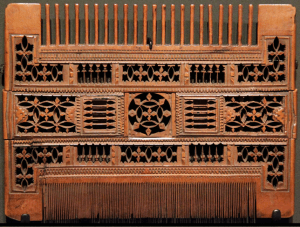
Pivoting carved comb from 16th century France
Comb with two flat sections that pivot into a cross shape, from 16th century France. Photo by Kotomi Yamamura
boxwood comb 16th century French
French boxwood comb, 16th century. Photo by Kotomi Yamamura
Photos

Photographers credited in captions. Links to originals here: First comb, Other combs, More picture info here
//
http://pagead2.googlesyndication.com/pagead/show_ads.js

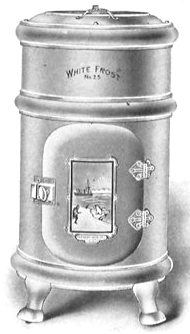
The White Frost Refrigerator: unique 100-year-old icebox

white frost refrigerator icebox
A White Frost Refrigerator from 1906. It had 2 revolving shelves and an internal water cooler.

Most iceboxes looked like plain wooden cabinets in the early 1900s. Without electric refrigeration, they were fitted inside with a space for  ice, which had to be topped up regularly to keep food cool and fresh.

Keeping the butter hard, the milk and cream sweet, and the meat from spoiling, is a part of the housewife’s trouble in the summer time.
White Frost ad from Carter’s Hardware, Sonora CA, 1913

The White Frost Refrigerator was the only cylinder-shaped icebox. A block of ice sat in a compartment under the lid and chilled air was vented into the food storage space below.  The makers said their distinctive model was:

  • More hygienic – easy-clean curved enamelled steel, food always in perfect condition
  • More scientific – better design, better insulated, economical with ice, revolving shelves
  • Desirable yet affordable – stylish, special, above-average price payable in installments

Advertising

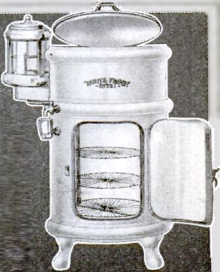
white frost refrigerator crystal water cooler
The "Crystal" water cooler looked good on the side of White Frost Refrigerators in the 1920s. It left room inside for 3 shelves.

Excerpts from their ads show what White Frost Refrigerator Co. and their dealers thought buyers wanted. (To read about the manufacturer, designer, patent etc. please scroll down the page.)

…rolled steel, galvanized and beautifully enameled…nothing to swell, warp or shrink…no corners to dig out, no shelter for germs…absolutely wholesome…circulation of air so scientifically directed…there can be no moisture from the ice in the food chamber
Weis & Fisher ad, Rochester NY, 1905

…only sanitary refrigerator on the market, not a splinter of wood, no waste of ice, clean and odorless
Cahn’s ad, Youngstown OH, 1908

…sparkling, cleanly white…harmonizes so well with the modern white kitchens
Trice-O’Neal Furniture Store ad, Florida, 1925

In 1914 this ad targeted the man of the house. An icebox with US government approval, and a loving wife into the bargain. (Red lines added.)

Of course the advertisers wanted to appeal to women, but they also needed to persuade men. An ad in Popular Mechanics showed “Bob” and his wife in icebox-inspired closeness.

Features

  • 47in high
  • 27in diameter
  • Holding up to 110lb. ice
  • Double walls insulated with asbestos or aerofelt,  and maltha (asphalt) with “dead air space”, later models with granulated cork
  • 3 coats of white enamel inside
  • Exterior white with nickel or brass trim, or golden oak finish
  • Easy to move, on wheels
  • White Frost Sanitary Refrigerator an alternative name
  • “Crystal” water cooler attachment allowing for an extra shelf – from 1919

Manufacturers  and inventor

The first White Frosts were made in Jackson, Michigan even before a full patent was granted in 1906. The president of the company making them was Hugh L. Smith, a hardware entrepreneur and director of at least 2 other businesses. He also bought the Boeck Stove Company.

Charles H. Boeck patented various stove designs and other inventions too. His 1906 refrigerator patent describes him as assignor to the Jackson Metal Stamping Co. In the next few years he patented some improvements to the icebox. His 1919 patent for the water cooler attachment used a different company name: White Frost Refrigerator Co. White Frosts were sold through dealers in many different states, and were also available by mail order from Mechanic Street in Jackson. The price in its first few years was about $30, with a $20 end-of-summer bargain in Paterson NJ. By 1924 a store in Painesville OH was selling one at $74, reduced from over $90.

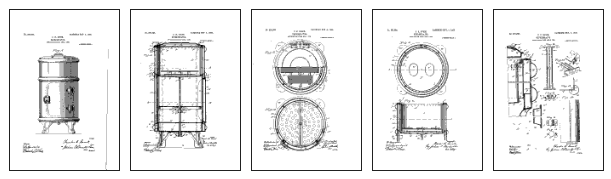
white frost refrigerator patent drawings
Boeck submitted 5 pages of drawings for the original 1906 patent.

//
http://pagead2.googlesyndication.com/pagead/show_ads.js

Basket making: ancient skills, traditional materials

Basket makers Tennessee USA
Baskets in the Tennessee mountains in 1931. Photo - Institute of Museum and Library Services.

Do you have any hand-made basketry in your home? From wicker chairs to straw hats, basket-making is an ancient craft that shows no signs of dying out, even though there may be fewer skilled makers than there used to be.

Basket-making stretches back for millennia:  a 7000-year-old basket is recorded here (pdf). There’s even evidence for basketry skills 25000 years ago (pdf). How many other crafts are equally ancient, and still hand-made today?

There can’t be many cultures (are there any?) where people haven’t woven grasses, reeds, leaves, canes, or twigs together to make useful and beautiful things. Until recently, turning vegetable material into containers or mats was a skill known and practised almost everywhere. And yet designs were very varied. An intimate understanding of local plants along with traditions built up over centuries meant every region had its own characteristic styles of – well, a lot of things – from bags, hats, fly-swats, and cradles to complete villages built on islands of woven reed in southern Iraq.

Beginnings of a bamboo basket in Andhra Pradesh, India. Photo by SriHarsha PVSS

Think of this stretching back for thousands of years. Even in very recent times, there were people in the western world continuing ancient basketry traditions. Now those of us who don’t have locally-produced basketry have a choice of imports from less industrialised countries . At the same time the developed world has basket-makers who are rediscovering the craft and re-awakening regional styles.  We don’t have to rely on baskets when industry offers us cheap, durable alternatives, but many of us like the look of “organic” woven containers  more than we like a plastic storage box.

Basketry, rope, brooms etc.

Basket making is closely related to rope and broom making, and may use the same plants and the same set of skills. Plaited rushes or grasses or “string” can create a flat braid suitable for making mats, or three-dimensional containers. This photo shows a Portuguese woman braiding a long flexible strip of this kind.

In this video a woman in the hills of central Italy shows us how it is/was done in her part of the world. If you like to live life at speed, be warned that the film evokes the slow, steady pace of this kind of work – no quick results here. (Click here if your browser doesn’t show the video on this page.)

http://vimeo.com/moogaloop.swf?clip_id=10550881&server=vimeo.com&show_title=0&show_byline=0&show_portrait=0&color=&fullscreen=1&autoplay=0&loop=0

weaving willow basketry
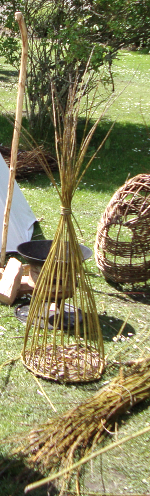
Willow weaving in progress at UK crafts fair. Photo by HomeThingsPast.

There’s a sense of connecting with prehistory watching this elderly lady demonstrating a process that begins with her cutting grasses. After twisting them into rope, people from her area would then plait and weave those cords into baskets: for example, donkey panniers for transport in a mountainous region.

She’s continuing a tradition handed down the generations, but there are many contemporary basket-makers who didn’t learn from their parents.  Practising it as an art which is also a journey into regional history is not uncommon: see, for example, this piece about baskets made of heather (erica) from the website where I first discovered the Italian film.

If you’re interested in making traditional things out of unprocessed plant materials, you may also like this page about broom-making.

Photos and video

Photographers credited in captions. Links to originals here:
An Ethnography of Basketry in Central Western Italy from Archaeological Traces on Vimeo.
Tennessee baskets, Indian bamboo basketry, or see more picture info here

//
http://pagead2.googlesyndication.com/pagead/show_ads.js

Trundle bed or truckle bed?

trundle bed 18th century
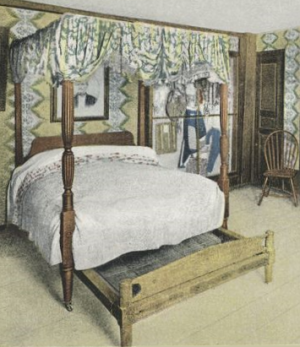
Trundle bed from Massachussetts, late 1700s.

What do trundle beds mean to you? The last one I saw was in a hotel where a small child’s rollaway lived under the main bed in daytime. This is exactly how they were used in thousands of American homes in the 19th century and before. And their history goes back much further too. For some people, trundle beds say “pioneers” or “log cabin” . You come across them in stories evoking that way of life.

By the time the dishes were all wiped and set away, the trundle bed was aired. Then, standing one on each side, Laura and Mary straightened the covers, tucked them in well at the foot and the sides, plumped up the pillows and put them in place. Then Ma pushed the trundle bed into its place under the big bed.
Laura Ingalls Wilder, Little House in the Big Woods

They were certainly used in more prosperous homes too, like the 18th century Lexington MA house in the first picture. Their origins are actually in the grandest homes of all.  Royalty and noblemen used to have a servant sleeping at the foot of the bed. Their high bed draped in fine fabrics easily hid a small, simple rollaway during the day. These rolling or trundling beds probably first came into use in late medieval times.

trundle rope bed
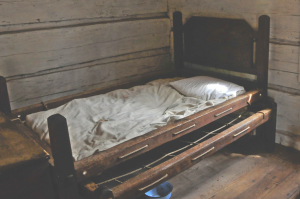
19th century cabin in Georgia with trundle. Both beds strung with rope. Photo by Beneteau Sailor.

Truckle beds are just the same thing by another name. Both truckle and trundle originally meant rollers or castors or little wheely things. There are a few other names around: trumble beds in some parts of the US, hurly beds in Scotland, and sometimes simply rolling beds, or the modern rollaway.

American trundle beds

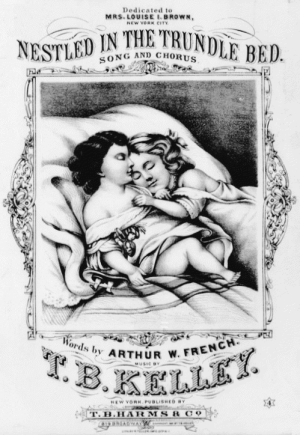
In the log cabin pictured right, both the big and small bed have cords to form a base for the mattress. Mattress covers were filled with corn husks, straw or any suitable plant material that was available, and spread over the rope “netting”. Surprisingly often, songs in the USA of the later 1800s and early 1900s mentioned trundle beds. They evoked a sentimental image of life back home, a cosy childhood with Ma and Pa. (See sheet music below.) But as life got more prosperous for many, with bigger houses, space-saving trundle beds had other meanings too, and some American children from small homes got called “trundle bed trash”.

European trundle beds

trundle bed 1930s
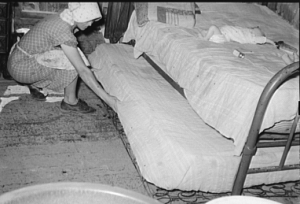
Oklahoma c1939 - trundle bed in a one room cabin occupied by tenant farmers.

In Europe, truckle beds or trundle beds were less likely to summon up visions of a warm, cosy family life. They were rooted in a master or mistress and servant tradition, where it was not at all unusual to have a valet or maid sleeping in a small bed near the big one, ready to be of service when required.

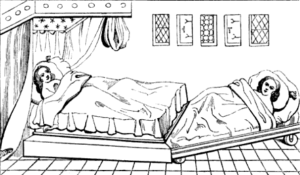
The medieval picture below comes from a French romance where the wife is in the servant’s truckle bed, unbeknownst to her husband, to find out about his goings-on in a story which is more risqué than The Little House on The Prairie. In 17th century London Samuel Pepys’ maidservant slept in the room with both him and his wife, on occasion.

So all to bed. My wife and I in the high bed in our chamber, and Willet in the trundle bed, which she desired to lie in, by us.
Pepys’ Diary, 1667

trundle bed 15th century
Trundle bed for a nobleman's valet. Black and white sketch of illustration in 15th century French manuscript: Roman du Comte d'Artois.
victorian trundle bed
"Nestled in the trundle bed" sheet music with sentimental 19th century picture. USA, 1880s
Photos

Photographers credited in captions. Links to originals here: Rope bed, or see more picture info here

//
http://pagead2.googlesyndication.com/pagead/show_ads.js

Marrow scoops, spoons & table manners

marrow spoons or scoops from 1700s and 1800s
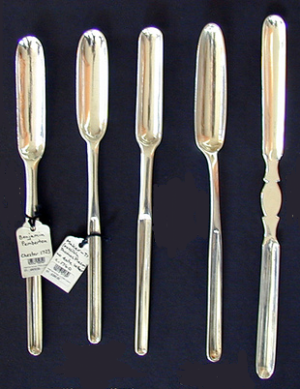
Silver marrow scoops from 1720s to 1850s (left to right). Photo by miladus

A silver marrow scoop is an elegant solution to a problem most of us don’t have today. How can you get the tasty marrow out of meat bones without abandoning your table manners?

Upper class diners adopted new rules of etiquette during the 1600s. Forks appeared on posh tables to help people eat with a less hands-on approach to cooked food. But forks didn’t help take the savoury jelly out of the marrowbones. You can get an idea of how this was done once upon a time by reading a mid-17th century etiquette book. The author thought it best for people to stop handling and “mouthing” bones altogether, but he would allow you to use one hand for meat bones as long as there was no gnawing, sucking, slurping etc. And definitely no banging, cracking, or biting. Get the marrow out neatly and decently – with a knife.

Suck no bones…Take them not with two hands…Gnaw them not…Knock no bones upon thy bread, or trencher, to get out the marrow of them, but get out the marrow with a knife…To speake better…it is not fit to handle bones, and much lesse to mouth them.
Make not use of a knife to breake bones…also breake them not with thy teeth, or other thing, but let them alone.
(Youths [sic] behaviour, trans. from French by Francis Hawkins, 1646)

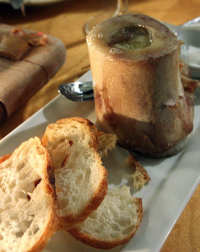
marrowbone served with toast or bread
Cooked marrowbone served with bread. Photo by Sifu Renka

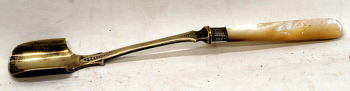
Before the end of the century marrow spoons had arrived, starting in the 1680s. These new implements for eating marrow had a rounded spoon at one end with a narrow scoop at the other. In 1710 one was described as “a marrow spoon with a scoop at the other end”.* Soon the spoon evolved into an elongated scoop, usually with a narrower version at the other end. Many more were made during the 18th century: an era when an impressive variety of new culinary paraphernalia was developed for the prosperous classes – from gravy warmers to caddy spoons.

I wish I could find a written description of someone taking marrow jelly out of a bone in the early days of the new scoops.  Did no-one write about it at all? Later there are recipes for dainty dishes of prepared marrowbone that could be eaten quite easily; by this time the bones were being cut and served in a special way. Diners could still enjoy the traditional delicacy, but without handling the bones at all, not even excavating with a knife as a polite alternative to sucking. Probably the late 19th century marrow scoop in the last picture on this page was intended for this kind of dish. It doesn’t look suitable for fiddly excavation of bones cut from a big joint of meat, or from a whole animal roast on a spit.

marrowbones served Victorian style
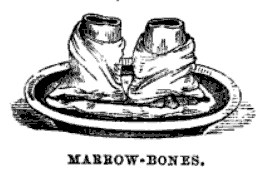
Marrowbones from Mrs. Beeton's recipe

Ingredients.—Bones, a small piece of common paste [pastry], a floured cloth. Mode.— Have the bones neatly sawed into convenient sizes, and cover the ends with a small piece of common crust, made with flour and water. Over this tie a floured cloth, and place them upright in a saucepan of boiling water, taking care there is sufficient to cover the bones. Boil the bones for 2 hours, remove the cloth and paste, and serve them upright on a napkin with dry toast. Many persons clear the marrow from the bones after they are cooked, spread it over a slice of toast, and add a seasoning of pepper; when served in this manner, it must be very expeditiously sent to table, as it so soon gets cold. Marrow-bones may be baked after preparing them as in the preceding recipe; they should be laid in a deep dish, and baked for 2 hours.
(Isabella Beeton’s recipe from 1861)

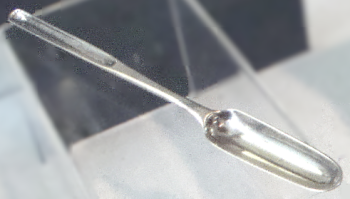
marrow scoop by spoon maker George Smith
Marrow scoop by George Smith - London 1780-1781. Photo by HomeThingsPast

The marrow scoop by George Smith III (picture left) comes from an important company of English spoon makers and silversmiths started by Thomas Chawner. They were active in London from the mid-18th to early 19th centuries.

marrow scoop late 19th C
Late Victorian marrow scoop - silver plate, mother of pearl handle. Photo by Leeds Museums and Galleries
Photos

Photographers credited in captions. Links to originals here: 5 marrow spoons – n.b. dates and details on original photo, cooked marrowbone, Gge Smith scoop by HomeThingsPast, Victorian marrow scoop. More picture info here
Notes

* From The Lucubrations of Isaac Bickerstaffe in Joseph Steele’s Tatler: “a marrow spoon with a scoop at the other end”.

See also: a pewter marrow scoop

//
http://pagead2.googlesyndication.com/pagead/show_ads.js

Household expenses for a “middling” 18th century family

Mary Johnson's household costs
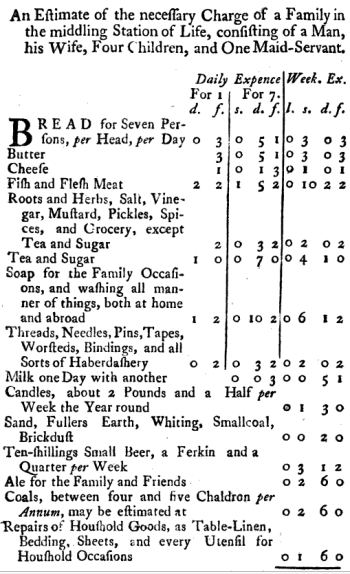
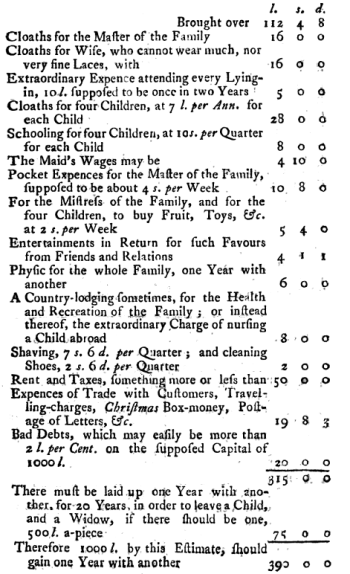
Weekly expenses for a middling family laid out in Madam Johnson's Present: Or, Every Young Woman's Companion in Useful and Universal Knowledge (1770 edition)

What could you afford if you were of “middling station” in England in the 1760s and 1770s? You would have plenty of beer, ale, meat, and soap, but no wine, according to a detailed budget in Madam (Mary) Johnson’s book on household management. She suggests the mistress of her middle class home will spend £16 a year on her own clothes, and acknowledges this does not allow for “very fine laces”.

Mother and children have pocket money for fruit and toys, and may occasionally go to a “country-lodging” for “health and recreation”. Yet this hypothetical family of two parents and four children have only one live-in maid.* This surely means Mother will have to work hard in the house, on top of the “lying-in” (childbirth) which is budgeted for every other year.

The largest sums go for savings, rent and taxes, clothing for four children, and money set aside to cover bad debts. The bad debts give us a clue that this 18th century “middling” family is a tradesman’s family. Other costs confirm this, like the “expenses of trade with customers”.

Some of the smallest items are the most unfamiliar to us. Who puts sand, fullers earth, whiting, smallcoal, and brickdust on their shopping list today? All these were for cleaning jobs except the smallcoal, or charcoal.

The haberdashery (sewing bits and pieces) expenses were essential then, but more like hobby accessories now. By the way, when she says worsted I think she means worsted wool thread for darning socks etc., not worsted woollen cloth.

Buying two and a half pounds of candles a week seems a lot to most of us. In England day lengths vary hugely between winter and summer so the candle budget would fluctuate accordingly. When she says candles cost 1s 3d “per week the year round” she means on average.

Mary Johnson's household budget 1750
Annual budget for the same middling family, as suggested by Madam Johnson.

A chaldron of coal was 36 bushels. Five chaldrons might have filled between 60 and 80 sacks, all delivered to the house, of course. A ferkin or firkin of small beer would have been about 8 or 9 gallons. Small beer was fairly weak, for everyday drinking, and considered inferior to ale.

The soap for “family occasions” was not for special occasions or events! Occasions here just means needs.

Money abbreviations:

  • l  … pound
  • s … shilling (20 in a pound)
  • d … penny (12 in a shilling)
  • f …  farthing (4 in a penny)

*The mistress of the house had other help as well as the live-in maid: a washerwoman would have needed the soap bought for use “abroad” (away from home), and a wet-nurse would be employed for “nursing a Child abroad”. And it looks as if repair costs covered work that would have been done by live-in servants in much bigger houses.

There’s no perfect way to adjust the prices to today’s values. This website suggests multiplying by somewhere between 75 and 100. That would mean the family’s annual expenditure was equivalent to £30,000+ in today’s world – maybe $50,000. All very rough estimates.

The first edition of Mary Johnson’s book (1753) says she was “for many Years a Superintendent of a Lady of Quality’s Family in the City of York”.

Want to compare prices, incomes etc. over the years?

This page on “changes in the value of money over time” has links to many useful resources.

//
http://pagead2.googlesyndication.com/pagead/show_ads.js

Metamorphic library steps, chairs and tables

convertible steps table
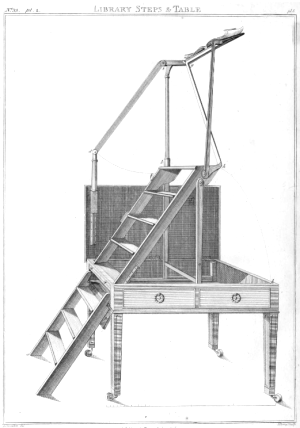
Sheraton first published this design for Library Steps & Table in 1793.

In the 18th century wealthy men with private libraries in their grand houses wanted elegant furniture around them. The upmarket cabinet-makers of the period created fine desks and chairs, but how could they design new, improved versions of the step-ladders needed for reaching books from the highest shelves?

One idea was to conceal steps under the seat of a long stool. Turned upright, its upholstered seat to the wall, it made a short ladder with three treads, each smaller than than the last: perhaps not a very stable arrangement. It is rare to find any of these on the antiques market, and it is unlikely that many were made, as better furniture soon followed.

Chippendale designed the kind described above in the 1750s, but in the next decade he created hinged steps that could be folded into a stool. This type can be seen at Harewood House and Nostell Priory in England. One was described at the time as a “large mahogany library stool with the seat to rise as a step ladder the seat stuff’d and cover’d with black leather”. (Nostell Priory accounts 1767) The other was given a neo-classical look with rosewood veneer and marquetry.

Benjamin Franklin had something better than a stool: a leather-upholstered chair with steps beneath. There are claims that his seat was the first ever chair and steps combination. Whether or not this is true, it is comfortable enough to be a real reader’s chair: ideal for someone who loves books as well as good furniture.

Tables were part of this new wave of convertible library furniture, and a British patent for a dual-function table with steps was registered in 1774. Sheraton published a design for one of these library tables before the end of the century. (Picture above)

This design was taken from steps that have been made by Mr. Campbell, Upholsterer to the Prince of Wales. They were first made for the King, and highly approved of by him, as every way answering the intended purpose. There are other kinds of library steps which I have seen, made by other persons, but, in my opinion, these must have the decided preference, both as to simplicity and firmness when they are set up. The steps may be put up in half a minute, and the whole may be taken down and enclosed within the table frame in about the same time.
Thomas Sheraton, The cabinet-maker and upholsterer’s drawing-book, London, 1802 edition

metamorphic library chair steps
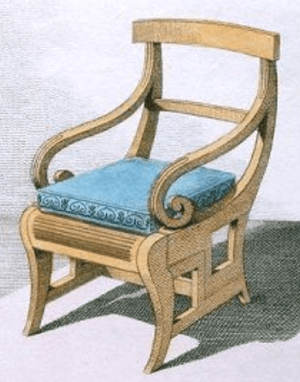
Steps folded under the seat of this Morgan & Sanders chair, designed c1811

The name metamorphic (shape-changing) was not used for the earliest pieces of library furniture, but appeared in a London patent of 1811. The first ever “patent metamorphic library chair” with curving arms spawned many varied chair designs, some quite plain, others very elaborate. Georgian or Regency pieces of dual-purpose library furniture can fetch thousands of dollars at antiques auctions, and even later Victorian metamorphic chairs may be quite valuable.

One 19th century curiosity is based on a library staircase design that was boxed in at the sides. One stair-tread was a hinged lid giving access to storage beneath. This was adopted as bedroom furniture and used in some homes as a commode to conceal the chamber pot for night-time use.

Note

Since I first wrote this short piece for another website, Clive Taylor has published a fascinating, detailed, and original dissertation on The Regency Period Metamorphic Library Chair.

//
http://pagead2.googlesyndication.com/pagead/show_ads.js

Drying clothes near the ceiling

laundry drying on ceiling rack
Drying clothes indoors in the laundry area of a big historic house in the UK. A high Victorian ceiling leaves plenty of space for this wooden rack with pulley and ropes for raising and lowering. Displayed as it would have looked a century ago.

It’s winter in northern Europe, and there’s no electricity. How can you dry your laundry? One of the best places of all is a laundry room in the servants’ quarters of a mansion house. A generous ceiling height means you can have frames for wet clothes and household linen in the warmest, dryest part of the room. The estate handyman would make them, and by the later 19th century he would probably add ropes and a pulley to raise and lower the rack. No need to climb on a chair to hang laundry.

ceiling clothes drying in swedish peasant home
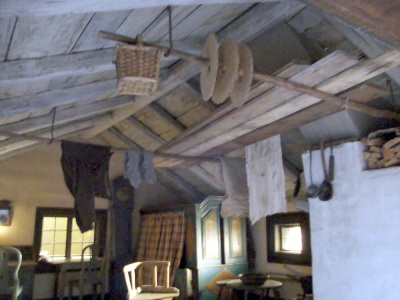
One pole near the roof holds laundry. The other has Swedish hard-bread rings and a basket that needs to be kept dry and airy. From a museum display of Swedish folk life 19th century style.

It was different in a small cottage. With life centred on one room there could be a lot hanging from the ceiling: foodstuffs needing a dry, vermin-free spot, baskets empty or full, medicinal and culinary herbs drying, as well as a steady stream of laundry and clothing soaked by bad weather.

One simple pole attached to roof timbers was better than nothing. Drying washing on frame airers by a fire is effective, but getting some of it up and out of the way is a relief in a small space.

Ceiling clothes pulleys used to be common in the UK, and they are still used in older houses where there is enough height in the room. In ordinary-sized houses they often used to be in the kitchen, so the fresh smell of newly-aired linen might be masked by a vague aroma of cooking. This is the only disadvantage I know of with ceiling drying.

Advantages are obvious. It’s simple. It’s cheap. It uses rising heat that’s wasted otherwise. It’s not much work spreading out the laundry and taking it down later. You can fix racks on lower ceilings if you don’t need the room when you’re drying things.

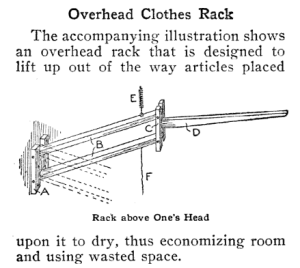
overhead clothes rack
Opening of instructions from 1911, sent in by a Kentucky reader of Popular Mechanics.

Although drying racks on the ceiling were not unknown in American homes of the early 1900s, they seemed to vanish later. But recently they have come back to the USA, perhaps for people interested in saving energy.  You could make one yourself, but you can buy ready-made ones with metal bits imported from the UK, plus US timber. The racks cost a bit more than in Europe, but they are still a practical, environment-friendly way of drying and airing for some people – and money-saving over time.

Clothes Driers vary from the hemp clothes-line, taken down after each drying, copper wires, stretched taut and left out permanently, to revolving driers mounted either on a post in the yard or on a projecting arm from a porch or window. Indoor driers vary from the clothes horse to a rack which is pulled by pulley to the ceiling (very convenient for limited spaces, costing about $5.00).
From: Laundering, by Lydia Ray Balderston, Philadelphia, 1914 & 1923)

An easy way to have your own ceiling clothes airer

The traditional UK pulley clothes dryer is now available in the USA from Amazon.com. There’s a range of sizes and fittings come in different colours. Click the one on the left if you’re in the US. The one on the right comes from Amazon UK.

USA:                               UK:        

Photos

Photos on this page by HomeThingsPast.
More picture info here.

Mrs. Beeton’s pastry essentials

Victorian pastry making tools
Victorian pastry-making equipment suggested by Isabella Beeton in 1861.

Mrs. Beeton knew it took time to learn how to make good pastry, which she called paste.

…the art of paste requires much practice, dexterity and skill…
Isabella Beeton, 1861

Her main tips are:

  • Pastry-making utensils must be kept scrupulously clean and not used for anything else.
  • Use a light touch with cool hands and work in a cool place.
  • Water and/or butter must be mixed in gradually.
  • Tins, dishes etc. must be well buttered.
  • Rich pastry must be put in the oven promptly, as soon as it’s made.

Cooking temperature

Her other tips are all about oven heat and are not relevant to owners of electronically controlled ovens. Just as well, because she uses terms that mean little to us. A raised pie needs a “soaking heat”. Puff pastry won’t rise in an oven that’s too “slack”.

Equipment

After rolling the pastry, ideally on a cool marble slab, you could use corner cutters for a neat finish on a square pie. There were plenty of shaped ornamental cutters available in the 1860s or the wheel on the end of the paste-pincers was good for cutting  pastry shapes freehand. The flutings on the wheel would make a patterned edge like pinking shears do on fabric.

The paste-pincers are for pressing together the edges of the top and bottom of a pie to stick them as firmly as possible. These are new to me and I imagine they could be quite useful. Please do comment if you’ve ever used such a thing.

The picture of the jagger isn’t very clear but it looks like an interesting way of making a decorative edge on pies and tarts: an alternative to pressing edges with the prongs of a fork. The raised pie mould is magnificent but how easy would it be to get the pastry out in good condition? Victorian cooks did work a lot with moulds, including the gorgeous copper jelly and pudding moulds that look so splendid hanging on the walls of historic kitchens, so perhaps they wouldn’t have had any trouble turning out a fine raised pie.

A jagger wasn’t just for pastry. It could also mean a toothed chisel, and other similar tools. We don’t use the word now, though jagged edges are still with us. Jagged suggests something undesirable to me, not really a decorative feature

Mix the eggs with flour…cut them the shape of a long narrow leaf…cut them with a jagger so they will be notched.

from the New York Voice, 1892

She didn’t mention pie funnels.

//
http://pagead2.googlesyndication.com/pagead/show_ads.js

A butter worker in the kitchen?

dasher aka plunger churn
Woman with traditional dasher churn for making butter, around 1905, Wisconsin.

No, not the long-skirted woman. A butter worker is a piece of dairy equipment. But there’s churning and other stuff to do before you use a traditional, non-mechanical butter worker. Scroll down to find a video link if you want to see this right now.

The woman in the photograph has an old-fashioned dasher churn with lid and long handle. It makes butter when someone fills it with cream and then plunges the stick up, down and around. But the end result of churning is not good butter. To begin with, there are lots of little buttery fragments swimming in thin buttermilk. You need to strain these through cloth (like butter muslin) and let the buttermilk drain into a pail.

In the cloth you now have a lump of nearly-ready butter. It’s rinsed to flush out the remaining buttermilk, but it’s still damp and not pure butter in a smooth coherent piece. You may squeeze the lump between wooden boards to press out the last drops of milky water and encourage the butter to form into a whole. Next you “work” the butter, while mixing in salt evenly, with wooden butter hands on a board, or with the back of a wooden ladle or a presser in a bowl.

A new kind of butter worker

butter worker in 19th century USA
Old Wisconsin farmhouse with butter worker on display in the kitchen, to the left of the table. Photo by Shihmei Barger

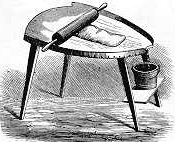
A different kind of butter worker emerged in the first part of the 19th century. The big picture shows one of the new kind in the kitchen of a German-American Wisconsin farmhouse. It seems like a good design: tilted to help liquid drain away through the holes, simple to make with home carpentry skills, and easy to operate. Moving the rod from side to side over the butter will press it and “work” it into good shape.

American butter worker from the 1800s

The simplest of the “modern” butter workers are generally only slightly more complicated than using a rolling pin on a wooden table. In the course of the 1800s more sophisticated combinations of roller and board were introduced. Rollers cranked by a handle, using metal fixings, lightened the work without being too complicated or expensive. People started to patent a variety of designs.

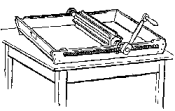
Butter worker with handle and roller
Butter worker from around 1880 with roller running on tracks and operated by turning handle.

In the picture the kitchen looks crowded with the butter worker and of course it is not a likely place for it to have been originally. You always need to do dairy work in a cool place even if you don’t have a dedicated dairy building. In a traditional kitchen the hot stove or hearth makes the room unsuitable for making butter or for doing any other work with milk or cream.

Butter making video

If you want to see the whole process, watch this video.

First you see the simplest way of making butter. A dairymaid skims cream off flat dishes of milk, churns, drains, rinses and works the butter before shaping a block with wooden “Scotch” hands aka butter pats. (She makes it look easy. Practice makes perfect.) Then the film shows mechanised churning with an end-over-end churn of a late 19th century or early 20th century type.

A butter worker from the 1840s, and one from the 1890s

butter worker 1890s with dairy school students
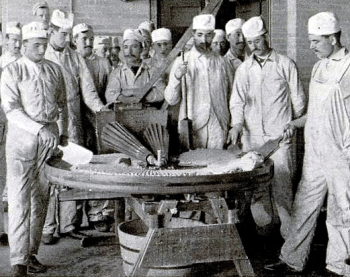
Students at the Wisconsin Dairy School with a butter worker, c1894.

Among the implements particularly worthy of notice, was a butter-worker, presented by Amherst Hawes, from the farm of Col. J. W. Lincoln, Worcester [Mass.]. It was a kind of brake. A marble slab placed on a table, with a slight declivity to let the buttermilk run off, formed the place for working the butter. A fluted roller, to which was attached a handle three or four feet long, fastened at the lower end to a swivel, constituted the power for working the butter, which was done by passing the roller backwards and forwards over it, applying as much pressure by means of the hand, as is required.
From: The Cultivator, A Monthly Journal to Agriculture, Horticulture, Floriculture and to Domestic and Rural Economy, Albany NY, 1844

Photos

Photographers credited in captions. Links to originals here: Woman with churn and Kitchen picture. Also see more picture info here.

//
http://pagead2.googlesyndication.com/pagead/show_ads.js